



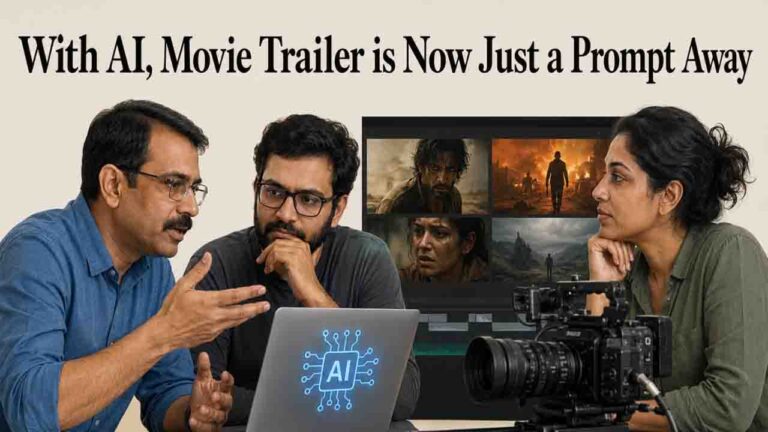
MUMBAI: The Indian entertainment industry has entered a new phase as producers in Hindi and regional cinema begin using generative artificial intelligence (AI) to pitch project ideas to investors and distributors. Amid rising production costs and high box-office uncertainty, filmmakers are increasingly steering away from traditional verbal script narrations, choosing instead to create AI-assisted trailers and concept films to showcase their final vision.
According to a media report, “AI has completely changed how people present their ideas,” says Akul Tripathi, filmmaker and former COO at IN10 Media Network. “Today, producers in the industry are creating AI-assisted trailers based on film scripts and explaining their films’ vision in a clearer manner. These AI-generated trailers help financiers, actors, writers, and other collaborators clearly understand a film’s idea and vision.”
The ability to establish a project’s visual tone, look, and feel before shooting begins is driving this rapid adoption. Naveen Chandra, founder of 91 Film Studios, notes the shift in studio operations: “Earlier, there was no option but to sit through a film narration. Today, a studio like ours reads 300 screenplays in different languages. With the help of AI, one can turn a screenplay into storyboards and then storyboards into a fully visualised film. This makes it easier to judge a story, its look, and even the budget before production.”
The practice is gaining traction across regional hubs. Industry sources and distributors point out that in Kerala, specialized tech firms are already providing tools to generate both AI-assisted trailers and entire feature-length concept films. Currently, AI can translate a written screenplay into a two-hour visual guide.
Producers typically develop 4-to-5-minute AI-assisted trailers to pitch their scripts. Since the financial outlay primarily covers software licenses and prompt-generation manpower, a short pitch trailer costs under Rs 5 lakh. A full-length, AI-generated concept film—without original music—costs between Rs 70 lakh and Rs 80 lakh. Financially, this serves as a viable proof of concept. Suniel Wadhwa, co-founder and director of Karmic Films, explains: “For many projects, spending a few lakhs on an AI-assisted proof of concept can significantly improve the chances of raising funds for a film worth several crores.”


Beyond funding, AI is also reshaping how Indian films reach broader audiences. According to a Mint report, filmmakers are utilizing the technology to streamline translation, voice synthesis, lip-syncing, and localization, making multilingual movie releases quicker and more cost-effective. High-profile upcoming projects, such as the Ranbir Kapoor-starrer ‘Ramayana’, are reportedly planning dubbed releases in more than 40 languages using these tools. “AI-powered technologies are increasingly assisting with translation, voice synthesis, lip synchronisation and localisation, helping streamline several parts of the process,” says Kaushik Das, CEO of AAO NXT.
However, a section of the industry remains highly skeptical of integrating AI so early in the creative pipeline due to substantial intellectual property and copyright risks.
“There is a big challenge in making AI-assisted trailers or films from scripts,” warns Shaaminder Malik, a distributor and film trade analyst. “When one uploads a screenplay in an AI tool, one is exposed to a risk of losing control of it. Scripts, storyboards, and AI-generated outputs can become available for others to copy or use to create their own works. Even if one pays to use an AI software, there is no guarantee one’s ideas are protected.”
As Indian cinema balances the financial relief of cheaper, visual pitches against these unresolved copyright and voice ownership issues, the scale and speed of AI’s integration will rely heavily on future legal protections.