



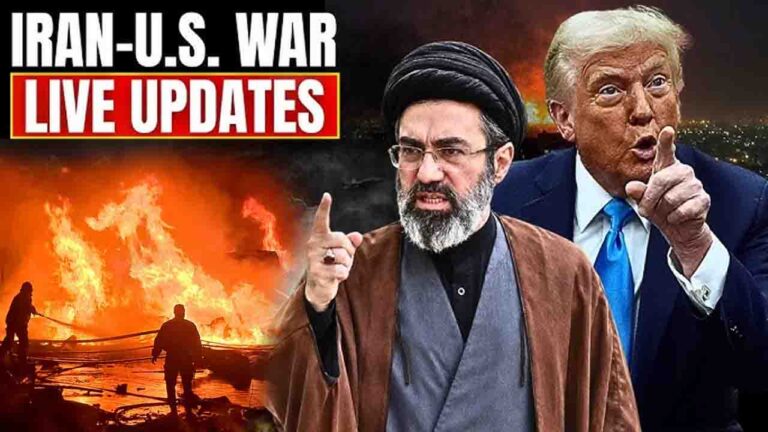
NEW DELHI: Tensions in the Middle East escalated sharply as the United States reimposed a naval blockade on Iranian ports, triggering a fresh exchange of missile strikes between both sides. The military escalation poses a direct threat to global energy supplies flowing through the region.
The US intensified its military action against Iran with a series of airstrikes. This move comes in response to Iranian attacks on commercial vessels in the crucial Strait of Hormuz shipping lane. U.S. Central Command (CENTCOM) confirmed that its forces completed a fresh round of military strikes early Wednesday morning, concluding an operation that lasted approximately seven hours.
The targeted American operations focused heavily on Iran’s missile and drone launch sites, coastal defense systems, and naval assets. While the strikes were extensive, Iranian authorities have not yet released official figures regarding casualties or structural damage.
The renewal of the naval blockade has further weakened an interim agreement aimed at ending the conflict. It has also heightened anxieties regarding potential retaliatory strikes against nations hosting US military bases.
For several days, Iran and its regional adversaries have engaged in regular retaliatory strikes. Both sides are vying for control over the critical waterway, which typically facilitates the transit of nearly 20 percent of the world’s oil and natural gas supplies. The ongoing friction has significantly raised the specter of a full-scale regional war.


The United States had initially enforced this blockade in mid-April but lifted it in mid-June following an interim agreement. The pact had established a 60-day window for negotiations covering multiple issues, including Iran’s nuclear program. However, mounting friction in the Strait of Hormuz stalled the diplomatic talks.
US President Donald Trump announced the reimposition of the blockade on Monday (July 13), initially declaring a 20 percent tariff on ships traversing the Strait of Hormuz. Hours later, he rescinded the tariff decision following direct requests from allied Arab nations in the Gulf region.
Prior to enforcing the blockade, the US launched a major airstrike against Iranian targets. Following this, missile alerts were activated early Wednesday in Bahrain and Kuwait as Iran launched a barrage of missiles and drones. This followed a series of persistent strikes that have placed immense strain on ceasefire efforts. Hours after the blockade took effect, Iranian state media reported gunfire in the Strait of Hormuz but provided no further details.
Admiral Brad Cooper, commander of US Central Command, stated that Iran has fired dozens of missiles and drones at neighboring Arab nations in the Gulf. “The US military is holding Iran accountable for its unprovoked aggression, which consistently puts innocent lives at risk,” Admiral Cooper said.
The US military presence in the Arabian Sea currently comprises at least 19 warships. The deployment includes two aircraft carriers and an amphibious assault ship carrying over 1,000 Marines. According to Central Command, hundreds of military aircraft are also active across the Middle East.
Following the launch of joint military operations by the US and Israel against Iran on February 28, Tehran had virtually halted transit through the Strait of Hormuz using targeted attacks and threats against shipping. The disruption caused a sharp spike in the global prices of oil, fertilizers, and other essential commodities.
President Trump stated on Tuesday that several regional kings and emirs had contacted him, offering billions of dollars in investments within the US as an alternative to the shipping tariffs. “I would prefer investment over tariffs, as I believe no one should have to pay a fee to pass through this strait,” Trump said, though it remains unclear if these proposed investments are distinct from previously announced plans.
Speaking to Fox News on Tuesday night, Trump warned that the US would execute further strikes on Iran within the next two days if negotiations failed to resume. He added that infrastructure like bridges and power plants could be targeted next week, warning, “Make a deal, or you will have nothing left.”
Tensions climbed further as Iran targeted vessels near Oman in a maritime zone monitored by the US military. The US has warned it will use force to keep the strait open if required, though experts note this would demand a substantially larger naval fleet and potentially thousands of additional troops. Criticizing the continuous American strikes, Amir Saeid Iravani, Iran’s Ambassador to the United Nations, stated, “The US is not the victim, but the aggressor.”
US Central Command had also struck multiple Iranian positions on Tuesday. While Iran confirmed those strikes, it withheld details on damage or casualties. Hours after the US declared an end to its latest operations, explosions rocked at least four separate locations in the Iranian city of Bushehr. Additional blasts were reported in Ahvaz and Bandar Abbas. These developments have fueled speculation that certain Gulf Arab states may be launching unacknowledged retaliatory actions against Iran.