




NEW DELHI: The Government of India has activated a comprehensive inter-ministerial strategy to stabilize domestic fuel supplies and ensure the safety of Indian maritime assets following recent escalations in West Asia and disruptions in the Strait of Hormuz.
Domestic Fuel Stocks and Distribution Stability
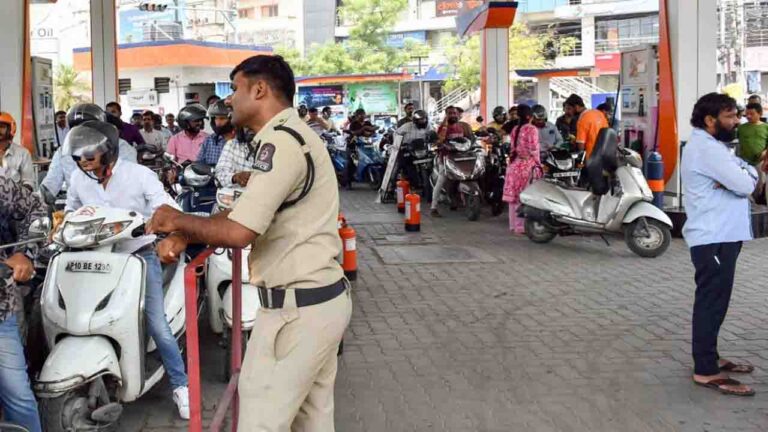
The Ministry of Petroleum & Natural Gas confirmed on Saturday that national inventory levels for petrol, diesel, and Liquefied Petroleum Gas (LPG) remain robust. Officials have discouraged panic buying, noting that all retail outlets are operating at standard capacity. To mitigate the impact of volatile global crude prices, the Centre has maintained an excise duty reduction of ₹10 per litre on petrol and diesel, supported by export levies on diesel and aviation turbine fuel to prioritize domestic requirements.
Distribution data reveals high operational efficiency, with 51 lakh domestic LPG cylinders delivered within a 24-hour window. Furthermore, 5.7 lakh 5-kg Free Trade LPG cylinders have been circulated since March 23 to assist those without permanent address proof. In the natural gas sector, over 3.5 lakh Piped Natural Gas (PNG) connections have been activated since March, part of a broader push toward alternative energy for households and commercial establishments.
Enforcement Measures Against Hoarding
To prevent artificial scarcity, enforcement agencies have launched a nationwide crackdown on black marketing. In a single day of operations, over 3,700 raids were conducted, resulting in 1,000 show-cause notices and the suspension of 27 LPG distributorships. State governments and Union Territories have been instructed to establish dedicated control rooms and conduct daily briefings to neutralize misinformation.
Prioritizing Industrial and Fertilizer Production
Beginning April 6, the government will increase natural gas allocations to the fertilizer sector, raising supply from the current 70–75% to 90% of average consumption. This move, coupled with high-capacity refinery operations and increased domestic LPG production, is intended to sustain industrial output and agricultural stability during the geopolitical transition.



Maritime Safety and the Strait of Hormuz
The Ministry of Ports, Shipping and Waterways (MoPSW) is currently monitoring 17 Indian-flagged vessels and approximately 460 seafarers situated in the western Persian Gulf. Highlighting the success of security protocols, the LPG vessel Green Sanvi recently completed a transit of the Strait of Hormuz, delivering 46,650 metric tonnes of cargo safely.
A 24×7 control room remains operational to track maritime developments. To date, 1,320 Indian seafarers have been repatriated, with 190 returning in the last 24 hours.
Repatriation and Consular Assistance
The Ministry of External Affairs (MEA) has facilitated the return of more than 6.75 lakh Indian nationals from West Asia since late February. Due to regional airspace restrictions, alternative transit routes through Saudi Arabia, Armenia, and Jordan have been established.
In Abu Dhabi, Indian authorities are providing medical and administrative support to five nationals injured in a recent incident; four have been discharged, while one remains under supervised medical care. The government continues to advise citizens to opt for energy conservation and explore alternative fuels, such as PNG and electric cooking, to alleviate pressure on the national supply chain.