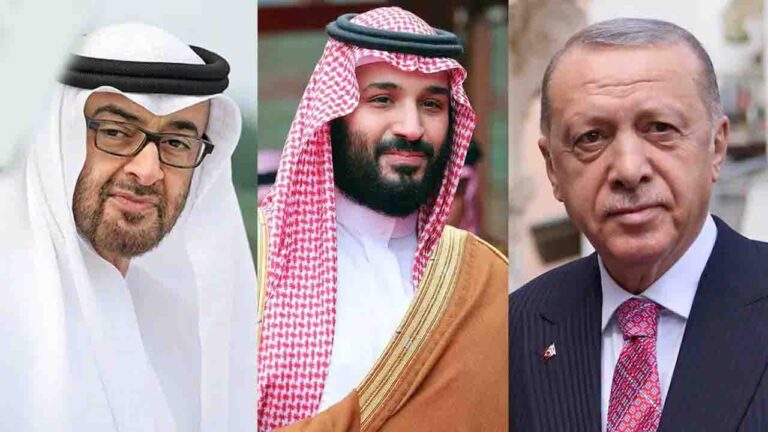

Middle East Crisis: In a significant structural shift for regional trade, Saudi Arabia, the United Arab Emirates, and Turkey are actively pursuing alternative land and sea routes to bypass the increasingly volatile Strait of Hormuz. The move comes in direct response to the mounting economic disruption triggered by the recent blockade of the critical waterway.
According to a report by the South China Morning Post, the three governments are fast-tracking joint initiatives involving land-based rail links, integrated maritime corridors, and expansive pipeline projects. The primary objective is to permanently reduce reliance on routes transiting through the Strait of Hormuz and the Red Sea.
The economic urgency follows the blockade imposed on February 28 after a joint military operation by the United States and Israel against Iran. The closure severely impacted the global economy, given that the Strait serves as the principal maritime channel for global energy supplies.
Experts are describing the coordinated effort as a fundamental infrastructure transformation aimed at moving away from dependence on vulnerable chokepoints in the Gulf region. The planned routes involve diverting cargo movement from UAE and Oman ports situated outside the Persian Gulf, transporting goods through Saudi Arabia into Jordan, and then onward through Egypt’s Suez Canal or Syrian ports to the Mediterranean Sea.
Several operational links are already functional, including a sea-land corridor connecting UAE ports with Saudi Arabian terminals and a newly launched Jordanian rail service introduced this year. Additionally, Saudi Arabia has initiated a freight service from its Neom port, linking Gulf countries and Iraq to the Suez Canal.


In parallel, Saudi Arabia, the UAE, Turkey, and Jordan have initiated discussions to revive the historic Hejaz Railway, which connects Istanbul to Jeddah via Amman and Damascus. Reinforcing this strategic drive, regional leaders at a recent GCC summit in Jeddah agreed to accelerate the development of a regional railway network linking Saudi Arabia with the UAE, Qatar, Oman, Kuwait, and Bahrain. Talks are also underway to establish a multi-country energy grid for oil and gas pipelines, alongside new electricity and water systems.