
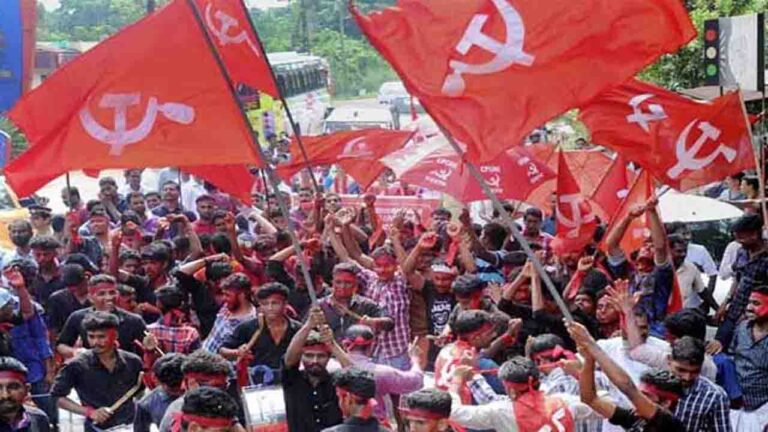
The political influence of Left parties in India is witnessing a sharp and steady decline. For the first time in 50 years, communist parties are becoming nearly irrelevant at the national level, with their impact now confined to a handful of states. This marks a significant transformation in the country’s political landscape, where the Left once played a decisive role.
Over the last 25 years, the presence of Left parties in Parliament has drastically reduced. Parties that once influenced national policy by extending support to central governments are now struggling for their own survival. Their traditional vote base has eroded rapidly across several states, pushing them further to the margins.
If history is any indicator, West Bengal and Tripura were the strongest bastions of Left politics. The Left Front governed West Bengal for a record 34 consecutive years from 1977 to 2011. Tripura too witnessed a firm Left hold. However, after losing power in Bengal in 2011, the decline has been relentless. Today, Kerala remains the only state with a strong Left presence under the LDF government led by Pinarayi Vijayan.
The decline is starkly visible in Parliament. In 2004, communist parties acted as kingmakers for the UPA government at the centre. Now, their seat tally has fallen so sharply that they can no longer influence national policy. This downturn is not just an electoral failure but a result of shifting social and political equations across the country.
Experts cite multiple reasons for this weakening. The emergence of new political forces has cut into the Left’s traditional vote bank. A lack of strong local leadership in many states has further weakened the organisational structure. Young voters, meanwhile, are gravitating toward agendas of development, employment, and stable governance rather than ideological politics.



Organisationally, Left parties face fresh challenges. Their once-formidable cadre network has weakened in several regions. Moreover, in the age of digital and social media, the Left’s outreach has proven less effective compared to other political parties. Despite this, it would be incorrect to declare the Left entirely finished. They still command influence in Kerala, trade unions, and student organisations.
Still, the national footprint has shrunk considerably. The central challenge for Left parties going forward will be to adapt to the changing political environment. Embracing new issues, promoting young leadership, and strengthening their organisation may offer a path to revival. For now, however, their influence in Indian politics is visibly restricted to a limited sphere.