
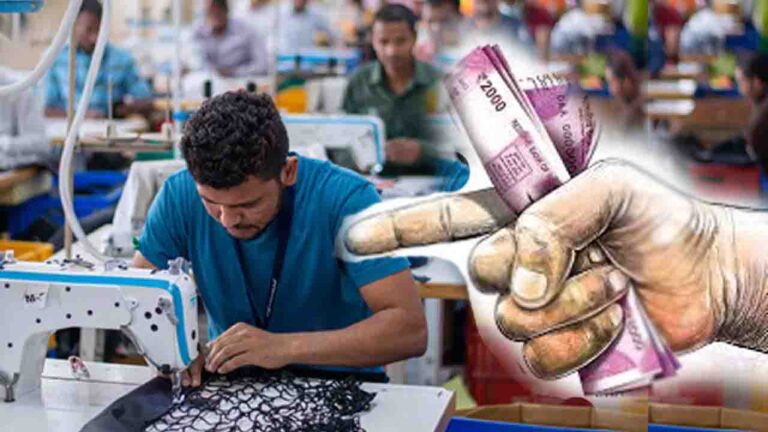
PMEGP Loan Crisis: India’s flagship self-employment and micro-enterprise support scheme, the Prime Minister’s Employment Generation Programme (PMEGP), is witnessing a major slowdown despite the government’s continued focus on job creation and entrepreneurship. Fresh financial data for FY 2025-26 shows a steep decline in bank lending under the scheme, triggering concerns over the future of small businesses and employment generation across the country.
According to the latest figures, total bank loans sanctioned under PMEGP dropped nearly 50 percent during FY 2025-26. While the scheme facilitated loans worth ₹12,315 crore in the previous financial year, the amount has now fallen sharply to ₹6,148 crore. The decline is being seen as one of the biggest setbacks for a programme designed to encourage self-employment and support micro and small enterprises.
The fall has not been limited to loan disbursement alone. The number of applications submitted under the scheme has also dropped significantly. Reports indicate that FY 2025-26 recorded the lowest number of applications in nearly a decade. Out of around 2.31 lakh applications received, only a small percentage reportedly received approval, reflecting growing caution within the banking system.
Experts tracking the MSME sector believe multiple factors are contributing to the slowdown. Economic uncertainty, stricter lending policies by banks, and rising concerns over non-performing assets (NPAs) are being viewed as major reasons behind the reduced flow of credit to small entrepreneurs. Several banks are reportedly becoming more cautious about financing new ventures due to repayment risks and inconsistent business performance among small enterprises.
The uncertainty surrounding the continuation of the scheme after the completion of the 15th Finance Commission period also added to the hesitation within the banking sector. Financial institutions reportedly adopted a wait-and-watch approach until clarity emerged regarding future policy support under the 16th Finance Commission framework. Concerns over irregularities and inconsistencies in implementation were also flagged during discussions around the scheme’s performance.



The MSME sector remains one of the most critical pillars of the Indian economy. Industry estimates show that nearly 33 crore people depend on MSMEs for employment. The sector contributes close to 31 percent to India’s GDP and holds a significant share in manufacturing and exports. Any slowdown in funding support for MSMEs therefore has a direct impact on employment opportunities and economic activity at the grassroots level.
Global economic conditions have further complicated the situation. Weakness in exports, tariff-related pressure on manufacturing units, and disruptions in industrial operations in regions such as Surat and Noida have affected small businesses in recent months. Several MSMEs reportedly faced operational challenges due to reduced orders, workforce shortages, and production disruptions linked to global trade uncertainty.
The impact on employment generation is already visible in official data. In FY 2022, PMEGP-supported projects reportedly created around 8.25 lakh jobs. However, by FY 2025, the number had declined to approximately 4.77 lakh. During FY 2025-26, employment generation improved slightly to around 5.31 lakh jobs, but it still remained far below earlier levels.
The decline in job creation has become a matter of concern at a time when the government is simultaneously focusing on large-scale employment initiatives and startup-driven economic growth. PMEGP has long been projected as an important mechanism to support first-time entrepreneurs, especially in rural and semi-urban India, where access to formal employment opportunities remains limited.
Despite the slowdown, the government has increased budgetary support for the programme. For FY 2026-27, the allocation under PMEGP has been raised to ₹4,500 crore, compared to nearly ₹2,500 crore in the previous cycle. However, policy analysts argue that a higher budget alone may not revive the scheme unless banks regain confidence in lending and the approval process becomes more accessible for genuine entrepreneurs.
Experts also point out that many aspiring business owners may now be discouraged from applying because of repeated loan rejections and uncertainty in the broader business environment. This could further weaken entrepreneurship growth unless corrective measures are introduced quickly.
The coming financial year is expected to be crucial for the scheme as policymakers attempt to balance employment generation, MSME expansion, and financial stability within the banking system.