

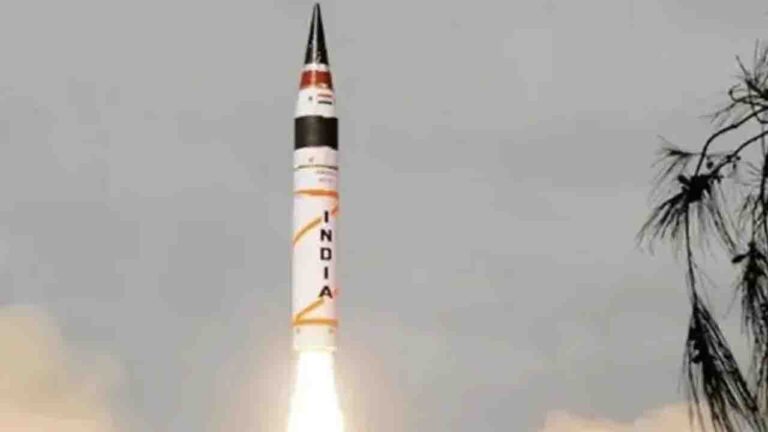
Agni-5 MIRV Missile Test: India on Saturday successfully carried out another flight trial of the advanced Agni-5 ballistic missile equipped with Multiple Independently Targetable Re-entry Vehicle (MIRV) technology. The missile was launched from Dr APJ Abdul Kalam Island off the Odisha coast and successfully demonstrated its capability to strike multiple targets spread across a vast geographical area.
According to the defence ministry, the missile was tested with multiple payloads directed at different targets located across the Indian Ocean Region. Officials confirmed that all mission objectives were achieved during the trial, including accurate tracking and successful impact verification through ground-based and ship-based monitoring systems.
The latest successful test places India among a select group of countries possessing MIRV-capable missile systems. At present, only the United States, Russia, China, France and the United Kingdom are known to operate similar advanced missile technology.
The defence ministry stated that the missile was “flight-tested with multiple payloads” aimed at “different targets spatially distributed over a large geographical area in the Indian Ocean Region.” Officials added that the trial once again demonstrated India’s capability to engage several strategic targets using a single missile platform.
Although the exact number of warheads carried during the test was not officially disclosed, defence scientists associated with the programme estimated that the MIRV-equipped Agni-5 could carry between four and five nuclear warheads. Each warhead can independently strike separate targets located hundreds of kilometres apart.



MIRV technology significantly increases the effectiveness of a country’s nuclear deterrence system. Unlike conventional ballistic missiles carrying a single warhead, MIRV-enabled missiles can deploy multiple warheads during a single launch. This capability makes interception more difficult and expands the missile’s strategic impact during a conflict scenario.
Defence Minister Rajnath Singh described the successful trial as a major advancement for India’s defence preparedness. He said the capability would provide “an incredible capability to the country’s defence preparedness against growing threat perceptions.”
India had first tested the Agni-5 missile with MIRV capability in March 2024 under the codename “Mission Divyastra.” Prime Minister Narendra Modi had publicly revealed the codename following the historic launch. The latest trial is being viewed as another important milestone in the operational development of the system.
The Agni-5 missile has been developed by the Defence Research and Development Organisation (DRDO). It uses a three-stage solid-fuelled propulsion system and has a strike range exceeding 5,000 kilometres. The missile forms part of India’s larger Agni missile series developed for strategic deterrence purposes.
The Agni missile programme includes Agni-1 with a range of around 700 kilometres, Agni-2 capable of striking targets up to 2,000 kilometres away, Agni-3 with a 3,000-kilometre range and Agni-4 with a strike capability of approximately 4,000 kilometres.
Officials also highlighted that the Agni-5 MIRV system uses indigenous avionics and highly accurate sensor packages developed within India. The maiden MIRV test conducted in 2024 was led by a woman scientist from DRDO and involved several women scientists in key technical roles.
The successful development of MIRV technology is considered a major achievement for India’s indigenous defence research programme. It reflects years of investment in missile systems, nuclear deterrence infrastructure and advanced military technology.
India continues to follow its nuclear doctrine announced in 2003, which is based on a “no first use” policy. Under this doctrine, nuclear weapons can only be used in retaliation against a nuclear attack on Indian territory or armed forces. However, the doctrine also states that any retaliatory strike would be massive enough to inflict “unimaginable damage.”
The authority to approve nuclear retaliation remains with the civilian leadership through the Nuclear Command Authority. The Prime Minister heads the political council responsible for strategic decisions, while the national security adviser leads the executive council.
India has also been steadily expanding its nuclear triad capability, enabling nuclear weapons to be launched from land, air and sea platforms. In April, the Indian Navy quietly commissioned its third nuclear-powered ballistic missile submarine, INS Aridaman, in Visakhapatnam under a classified strategic programme.
According to the Stockholm International Peace Research Institute (SIPRI), India possessed around 180 nuclear warheads as of January 2025. The report estimated China’s arsenal at approximately 600 warheads, while Pakistan was believed to possess around 170 nuclear weapons.
The latest Agni-5 MIRV test is expected to strengthen India’s long-range deterrence capability amid changing regional security conditions and increasing focus on strategic missile systems.