
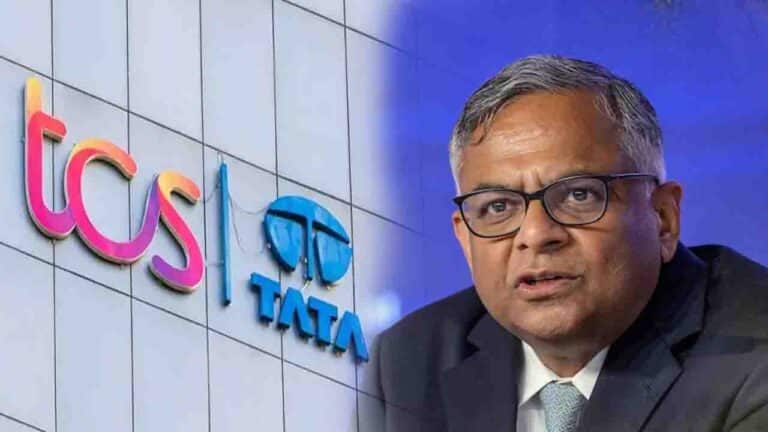
Mumbai: Artificial Intelligence is no longer just an additional layer of technology but is rapidly becoming the primary operational backbone and infrastructure for global corporations, Tata Consultancy Services (TCS) Chairman N Chandrasekaran stated.
In his annual letter to shareholders for the fiscal year 2025-26, Chandrasekaran emphasized that businesses worldwide are transitioning from isolated AI experiments to embedding the technology directly into their most critical enterprise functions.
According to the annual report, this systemic shift has already yielded significant financial returns for India’s largest IT services exporter. Driven by the large-scale deployment of its proprietary ‘Human+AI’ operating model, TCS clocked an annual revenue of $2.3 billion from AI-specific services alone.
Furthermore, the company’s next-generation technology portfolio—encompassing cloud computing, data analytics, and cybersecurity—contributed a substantial $11.5 billion to the total revenue pie.
Restructuring Global Supply Chains
Chandrasekaran noted that the upcoming phase of enterprise AI will fundamentally alter how businesses deploy capital, manage global supply chains, mitigate market risks, and handle customer interactions. Rather than treating AI as a trial project, corporations are integrating agentic AI solutions to handle complex organizational tasks autonomously.


To capitalize on this transition, TCS is designing an open, customizable ‘AI Operating System’ engineered to help diverse industries scale up autonomous AI tools quickly and securely.
Building India’s First AI-Focused Data Center
Addressing the global constraints around power availability, computing bandwidth, and geographical limits, Chandrasekaran highlighted India’s emerging positioning as a vital strategic alternative for international AI infrastructure.
As part of its future roadmap, TCS is preparing to establish India’s first dedicated AI-centric data center. The facility will be built to handle heavy computational workloads with a specialized rack density exceeding 160 kilowatts (kW).
The company is currently co-developing its ‘Infrastructure to Intelligence’ service suite through collaborative partnerships with global hyperscalers, frontier AI research entities, and industrial original equipment manufacturers (OEMs).
Financial Performance and Hiring Turnaround
The strategic update follows a robust financial performance in the final quarter of the fiscal year. TCS reported a 12.22 percent year-on-year increase in net profit for the March quarter, reaching Rs 13,718 crore, supported heavily by expanded profit margins.
For the full financial year 2025-26, the company’s consolidated Profit After Tax (PAT) edged up by 1.35 percent to reach Rs 49,210 crore, compared to Rs 48,553 crore recorded in the preceding fiscal year.
TCS FY25-26 Financial Snapshot
| Metric | Value |
| Full-Year Net Profit (PAT) | Rs 49,210 crore |
| AI Services Annual Revenue | $2.3 billion |
| Cloud & Cyber Security Rev. | $11.5 billion |
| Q4 Fresh Order Book | $12 billion |
Signaling a recovery in sector-wide tech employment, TCS successfully halted a consecutive two-quarter slide in its total workforce numbers. The firm added 2,356 new professionals during the March quarter, consolidating its total employee base at 5,84,519 as of March 31, 2026.
The company also secured fresh deal wins worth $12 billion during the quarter. Demand was led primarily by the North American market, which brought in $5.4 billion, followed closely by the Banking, Financial Services, and Insurance (BFSI) vertical at $2.8 billion.