
Abu Dhabi: India and the United Arab Emirates have dramatically scaled up their energy and economic alignment, engineering a massive expansion of India’s strategic petroleum reserves and establishing a $5 billion investment pipeline. The milestone agreements were finalized during Prime Minister Narendra Modi’s official visit to Abu Dhabi, occurring against the backdrop of heightened security anxieties in the West Asia region following recent drone and missile strikes.
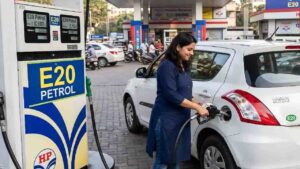
In intense bilateral discussions, India secured commitments from the UAE to store up to 30 million barrels of crude oil within Indian facilities, while also guaranteeing long-term Liquefied Petroleum Gas (LPG) supply chains. Simultaneously, Abu Dhabi rolled out a multi-billion dollar investment roadmap targeting India’s financial and infrastructure sectors, signaling strong institutional confidence in New Delhi’s domestic growth trajectory.
Multi-Sector Financial Injections and Infrastructure Push
The Prime Minister’s Office (PMO) confirmed that the $5 billion investment blueprint from the UAE is structured across three distinct financial vehicles designed to fortify key Indian corporate and infrastructure sectors:
Infrastructure Development: The Abu Dhabi Investment Authority (ADIA) and India’s National Investment and Infrastructure Fund (NIIF) are actively exploring deployment strategies for up to $1 billion in domestic infrastructure projects.
Banking Sector: In a major corporate banking play, the Emirates New Development Bank (ENBD) has committed $3 billion to infuse into India’s RBL Bank.


Non-Banking Financial Space: The UAE-based International Holding Company (IHC) will channel $1 billion into Sammaan Capital.
According to the PMO, these financial interventions reflect the UAE’s long-term commitment to India’s macroeconomic stability and validate the deepening bilateral strategic investment partnership.
Bolstering Energy Security and Strategic Reserves
The commercial centerpiece of the visit remains the agreement between the Indian Strategic Petroleum Reserve Limited (ISPRL) and the Abu Dhabi National Oil Company (ADNOC). The freshly inked strategic cooperation agreement aims to scale the UAE’s existing participation in India’s underground strategic oil reserves up to the 30 million barrel threshold, alongside collaborative blueprints for future gas storage units.
The UAE holds a unique position as the first foreign nation to partner with India on its strategic petroleum reserves, a relationship that dates back to a 2018 agreement for storing over 5 million barrels at ISPRL’s Mangaluru facility. Data highlights that the UAE was India’s fourth-largest crude supplier last year, accounting for roughly 11% of national imports, while dominating the domestic LPG landscape by fulfilling nearly 40% of India’s total requirements.
Defense Framework and Maritime Security Dominance
Beyond commercial ties, the geopolitical realities of West Asia loomed large over the leadership dialogue. PM Modi and UAE President Sheikh Mohamed bin Zayed Al Nahyan welcomed the signing of a comprehensive Strategic Defense Partnership Framework. This new framework paves the way for deeper defense-industrial cooperation, focusing heavily on maritime security, cyber defense, advanced technologies, joint military exercises, and secure intelligence sharing.
Addressing the recent security challenges in the region, including the aftermath of Iranian missile and drone strikes, PM Modi explicitly condemned the targeting of the UAE. He emphasized that such attacks remain unacceptable to the international community.
“The restraint shown by the UAE leadership during these challenging times is highly commendable. India stands shoulder-to-shoulder with the UAE now and will continue to do so in the future,” PM Modi stated, referring to the UAE President as his “brother.”
Ensuring Maritime Passage Through Hormuz
A central point of concern during the delegation-level talks was the maintenance of maritime stability in critical trade corridors. PM Modi clarified India’s unambiguous stance regarding the absolute necessity of safe, unhindered commercial shipping through the crucial Strait of Hormuz.
The Indian side stressed that maintaining an open chokepoint is fundamental not only to regional peace but to global energy security and food supply networks. The strategic diplomatic engagement follows immediately after PM Modi met with Iranian Foreign Minister Seyed Abbas Araghchi in New Delhi on the sidelines of the BRICS ministerial gathering, positioning India as an active diplomatic channel amid West Asian volatility.
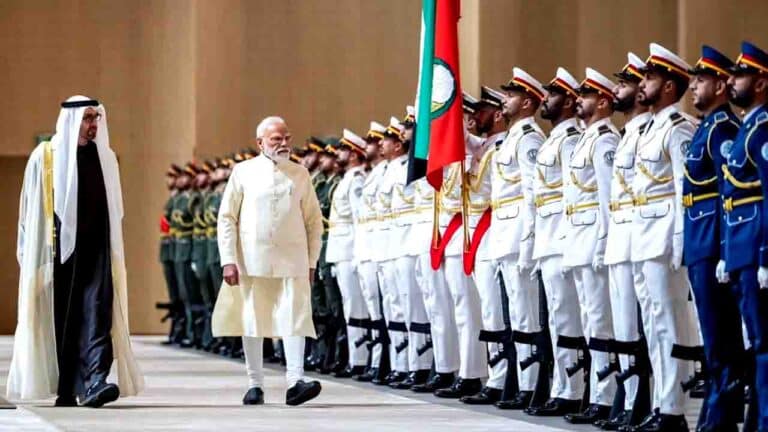
The high-stakes nature of the visit was reflected in the state reception at Abu Dhabi. The Prime Minister’s aircraft was escorted into UAE airspace by UAE Air Force fighter jets before receiving a formal guard of honor at the airport from senior state officials and President Sheikh Mohamed bin Zayed Al Nahyan.