

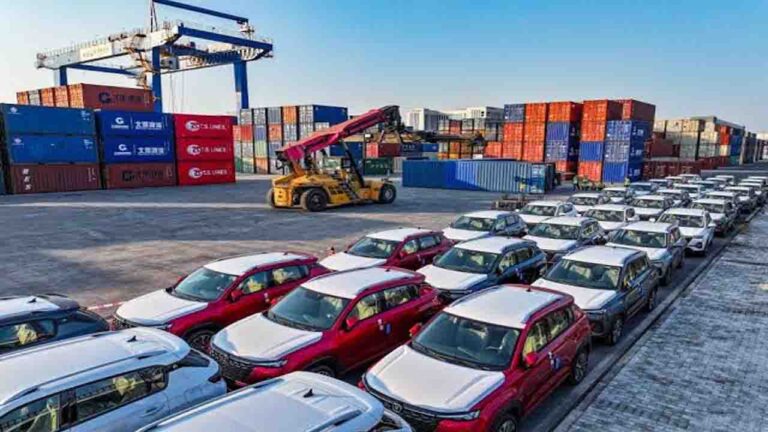

NEW DELHI: The central government on Friday issued a notification detailing concessional tariff benefits for vehicles imported from the United Kingdom, ahead of the India-UK Comprehensive Economic and Trade Agreement coming into effect this Wednesday.
The agreement outlines phased modifications to the Tariff Rate Quota (TRQ) over a 15-year period. While it brings a massive reduction in import duties on UK vehicles from nearly 110% down to 10%, it deliberately secures India’s domestic electric vehicle (EV) manufacturing ecosystem. This quota system will be applicable to both countries.
Industry sources indicate that the pact is unlikely to disrupt India’s premium automotive market immediately. Instead, competition within the luxury segment is expected to intensify gradually over the first five years as import duties drop to 10%. This phased reduction will make fully imported UK vehicles highly competitive against locally assembled models from luxury brands like Mercedes-Benz, BMW, and Audi, benefiting British brands like Jaguar Land Rover.
“The most significant outcome of this agreement is the window of opportunity it opens for Indian exports,” said Ravi Bhatia, President of automotive intelligence firm JATO Dynamics.
According to Bhatia, Indian-made electric, hybrid, and hydrogen-powered vehicles priced between 20,000 and 80,000 British Pounds will enjoy duty-free access to the UK market from the sixth year of the agreement. The export quota will scale up progressively, reaching up to 88,000 vehicles by the 15th year, presenting a substantial long-term opening for Indian manufacturers aiming to strengthen their global footprint.



“An initial quota of 20,000 vehicles in the first year accounts for less than 0.5% of India’s annual passenger vehicle market. While its immediate commercial impact remains limited, the agreement sets a crucial precedent for measured market access under a comprehensive free trade agreement, striking a balance between trade liberalization and domestic industry protection,” Bhatia added.
The duty reductions will be implemented in a phased manner rather than a single step. For large-engine vehicles, the import duty will drop from 110% to 30% in the first year, eventually hitting 10% by the fifth year. For mid-range vehicles, the duty will be slashed from 66% to 50% initially, before tapering down to 10% over the same five-year period.
The import quota will start at 20,000 vehicles, rise to 37,000 units by the fifth year, and provide cumulative access for up to 3,78,000 vehicles over 15 years. Crucially, these preferential tariff rates will strictly apply to vehicles that fulfill the ‘Rules of Origin’ criteria and are manufactured within the UK, excluding models manufactured in third-party countries.
The Directorate General of Foreign Trade (DGFT), under the Ministry of Commerce, has already issued a public notice outlining the mechanism to monitor the Tariff Rate Quota for these vehicle imports. The notification details the annual quota allocations, applicable in-quota customs duty rates, and the formal procedure required to obtain quota certificates.