



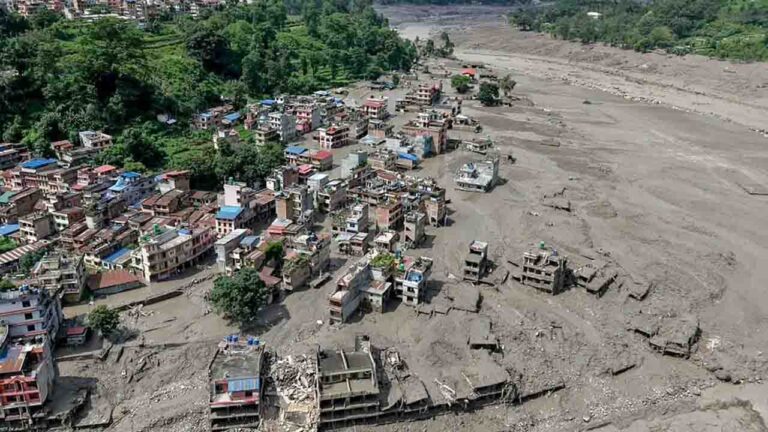
Nepal Flash Flood: A massive tragedy struck Nepal’s Rasuwa district along the Nepal-Tibet border on August 26, leaving at least 163 people dead and more than 1,000 missing. The devastating flash flood dismantled connectivity across several regions and destroyed 13 hydropower projects in its wake.
Despite no reports of heavy rainfall on the morning of August 26, the water level in the Bhote Koshi River surged suddenly around 9:00 AM. A violent wave of water, mud, rocks, and ice rushed downstream, catching residents completely unprepared.
Scientists and agencies have pieced together the exact sequence of events that led to the catastrophe:
1. Landslide Mimics Earthquake
At 8:37 AM on Wednesday, tremors were felt near the Nepal-China border north of Kathmandu. Initial reports from the United States Geological Survey (USGS) logged it as a magnitude 4.4 earthquake. However, USGS later clarified that it was not a tectonic earthquake, but rather a violent mountain landslide so powerful that it generated seismic activity equivalent to a 5.2 magnitude earthquake. A massive section of the mountain broke off with snow and rock, crashing straight into the Lhende Khola river—a tributary of the Bhote Koshi that flows from China into Nepal through deep valleys.
2. Formation of an Artificial Dam
Preliminary investigations and satellite images suggest that debris from the high-altitude collapse blocked the Lhende Khola river approximately 20 kilometers upstream. This debris temporarily dammed the river, creating a sudden artificial lake.



3. Temporary Dam Bursts
The temporary dam made of slush and rock failed shortly after forming. The trapped water surged downhill at extreme speed, carrying enormous volumes of soil, boulders, ice, and silt. The wall of debris flowed rapidly from Lhende Khola into the main Bhote Koshi river.
By 9:00 AM, the raging torrent struck the Rasuwagadhi border area and Timure, before sweeping downstream along the Trishuli River toward Nuwakot and lower-lying regions, destroying roads, bridges, and infrastructure along its path.
4. Steep Terrain Amplifies Destruction
The steep slopes and narrow valleys of the Himalayan region accelerated the flow of water and debris. The torrent moved so fast that floodwaters in the Galchhi area reportedly rose by 9 meters within just 30 minutes.
Ongoing Danger
The threat has not fully passed. Reports indicate that debris remains lodged in the upper stretches of the river. If water accumulates again behind this debris, a secondary flash flood could occur. Authorities and scientific teams from Nepal and China are actively monitoring satellite imagery, river discharge data, and seismic activity to assess potential future risks.