
An emergency fund for freelancers in India should usually cover 9 to 12 months of essential expenses, not the 3 to 6 months often quoted for salaried people. Your income can stop without notice, and there is no notice period, no provident fund payout and no employer health cover to fall back on. The right number comes from your expenses, not your income. This guide shows how to calculate it, where to keep it, and how to build it when your earnings change every month.
Table of contents
- Why freelancers need a bigger emergency fund
- Step 1: Find your essential monthly expenses
- Step 2: Choose your number of months
- Three worked examples
- Where to keep your emergency fund: the 3-layer plan
- How to build it on irregular income
- Should you pay off debt first?
- What is NOT an emergency (and what insurance does not cover)
- When to use the fund, and how to rebuild it
- Common mistakes
- A quick checklist
- FAQs
1. Why freelancers need a bigger emergency fund
A salaried employee usually has a fixed monthly income, a notice period, and sometimes employer-provided health insurance. A freelancer, consultant, gig worker or small shop owner often has none of these. Your risks are different:
- Client concentration. One large client leaving can cut income by half overnight.
- Delayed payments. Work is done, but the money arrives two or three months later.
- Seasonality. Some months are strong, others nearly empty.
- No paid leave. Illness or a family emergency directly reduces income.
- Gaps between projects. Even good freelancers have dry spells.
Surveys suggest most Indians are under-prepared. One widely reported survey found that only about 25% of Indians keep a dedicated emergency fund. For people with irregular income, that gap is even riskier.
2. Step 1: Find your essential monthly expenses
Do not use your income. Use what you must spend to keep life running for a month.
| Include | Leave out (for now) |
|---|---|
| Rent or home loan EMI | Dining out and food delivery |
| Groceries, gas, electricity, water, mobile, internet | OTT and app subscriptions |
| Insurance premiums (health, term) | Shopping and gadgets |
| Loan and credit card minimum payments | Holidays and travel |
| School or tuition fees | Lifestyle upgrades |
| Medicines and regular medical costs | Non-urgent home upgrades |
| Basic transport | |
| Work essentials (internet, software you cannot work without) |
Tip: Open your last three months of bank and UPI statements. Total the essentials. Use the highest month, not the average, so the number is safe.



3. Step 2: Choose your number of months
Start at 9 months and adjust with this simple score. Add one point for each “yes.”
- More than half of my income comes from one or two clients
- My income varies a lot from month to month
- I am the only earner in my household
- I have dependents (children or parents)
- I have an EMI or loan
- My work depends on one platform or one industry
| Score | Suggested cover |
|---|---|
| 0 to 1 | 6 to 9 months |
| 2 to 3 | 9 to 12 months |
| 4 to 6 | 12 months or more |
Two-income households can lean to the lower end. Single earners with dependents should lean to the higher end. This is a practical guide, not a formula from any regulator.
4. Three worked examples
These are hypothetical, to show the maths.
Example A: Freelance designer, single, Delhi
- Essential expenses: ₹45,000 a month
- Score: 3 (one big client, variable income, single earner)
- Target: 12 months = ₹5.4 lakh
- Milestone 1: 3 months = ₹1.35 lakh
Example B: Delivery or cab partner with a family
- Essential expenses: ₹22,000 a month
- Score: 5 (single earner, dependents, platform-dependent, EMI)
- Long-term target: 12 months = ₹2.64 lakh
- First goal: one month (₹22,000) within 3 to 4 months, then keep going
Example C: Small shop owner
Keep two funds so business shocks and personal shocks do not drain each other.
- Personal: ₹35,000 a month × 9 = ₹3.15 lakh
- Business reserve: fixed costs (rent, staff, EMI) ₹25,000 × 3 = ₹75,000
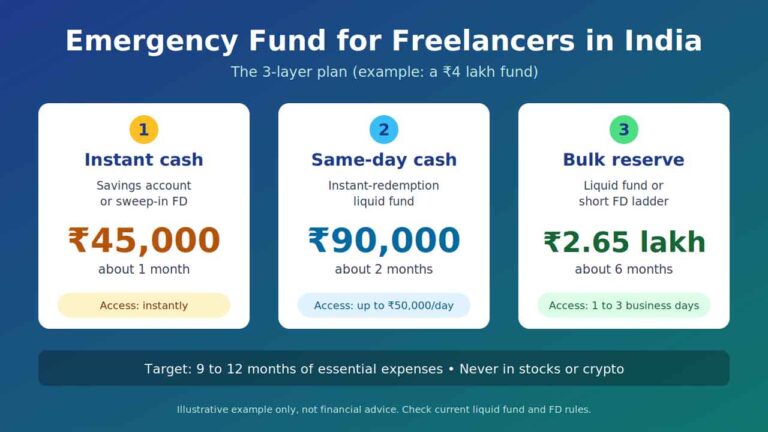
5. Where to keep your emergency fund: the 3-layer plan
A single account is either too accessible (you spend it) or too locked (you cannot reach it). Use layers.
| Layer | Purpose | Where | Example for a ₹4 lakh fund |
|---|---|---|---|
| Layer 1 | Instant cash | Savings account (or sweep-in FD) | ₹45,000 (about 1 month) |
| Layer 2 | Same-day or next-day cash | Liquid fund with instant redemption | ₹90,000 (about 2 months) |
| Layer 3 | The bulk reserve | Liquid fund, or a ladder of short FDs | ₹2.65 lakh |
What you should know about each option:
- Savings account: Fully liquid, but interest is low. Keep only what you need for immediate access.
- Liquid mutual funds: These invest in very short-term debt instruments. Redemption is normally credited on the next business day. Some schemes offer an instant redemption facility, typically capped at ₹50,000 or 90% of your holding per day, whichever is lower, so a large sum may take a few days to fully reach you.
- Exit load: Liquid funds usually charge a small graded exit load only if you redeem in the first 7 days. After that it is generally nil. Check your scheme.
- Taxes on liquid funds: For debt fund units bought on or after 1 April 2023, gains are taxed at your income tax slab rate. Returns are market-linked, so small dips in value are possible, though rare.
- Fixed deposits: Rates are known upfront, but breaking one early usually attracts a penalty (often around 0.5% to 1% off the rate), and some banks pay nothing if broken within a few days. Splitting into several small FDs (a “ladder”) avoids breaking the whole amount.
Do not keep the emergency fund in stocks, equity mutual funds, crypto or gold. A market fall could arrive exactly when you need the money.
6. How to build it on irregular income
The trick is to stop thinking in monthly amounts and start thinking in rules.
Rule 1: Pay yourself a “salary.”
Look at your lowest earning months over the past year. Set a baseline monthly amount to withdraw for personal use. Everything above it goes into the buckets below.
Rule 2: Split every payment on the day it arrives.
| Bucket | Suggested share (adjust to your situation) |
|---|---|
| Tax set-aside | Keep a separate account. Ask a CA what your tax and advance tax liability could be |
| Emergency fund | 15% to 20% of each payment until the target is reached |
| Personal expenses | Your baseline salary |
| Investments and goals | What remains after the above |
Rule 3: Automate. Set up a standing instruction or SIP into a liquid fund right after payments come in.
Rule 4: Windfalls go to the fund first. Any big project payment, bonus or refund adds to the fund until the first milestone is met.
How long will it take? To build ₹4 lakh:
| Monthly saving | Time to reach ₹4 lakh |
|---|---|
| ₹10,000 | about 40 months |
| ₹15,000 | about 27 months |
| ₹20,000 | 20 months |
| ₹25,000 | 16 months |
Break it into milestones: 1 month, then 3 months, then 6 months, then the full target. Small wins keep you going.
7. Should you pay off debt first?
It depends on the interest rate. Credit card balances that are rolled over can cost 30% or more a year, which is far more than any savings will earn.
A common sequence:
- Build a starter buffer of about one month of essentials.
- Pay off the high-interest debt aggressively.
- Then complete the full emergency fund.
Low-interest loans, such as some home loans, usually do not need to be cleared before you build the fund.
8. What is NOT an emergency (and what insurance does not cover)
Emergency: loss of major client or income, urgent medical costs not covered by insurance, essential home or vehicle repair you need for work, family emergency travel.
Not an emergency: a sale, a holiday, a new laptop you want, an upgrade, a wedding gift.
Ask before withdrawing: Is it unexpected? Is it urgent? Is it necessary? If any answer is no, use another source.
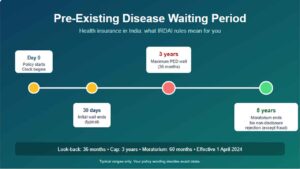
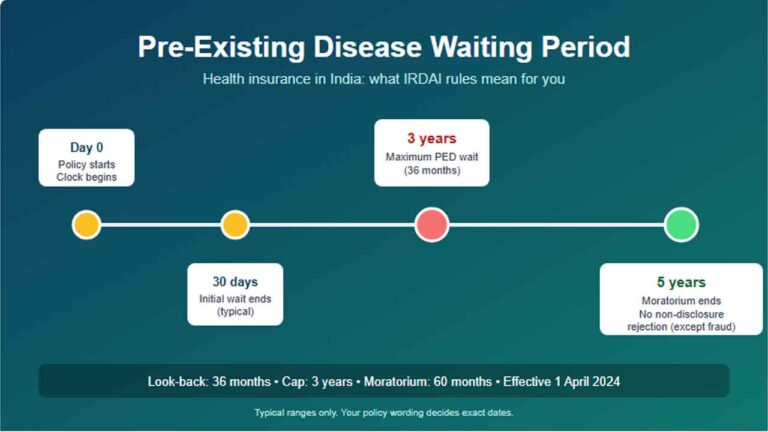
Insurance is not a substitute. Health insurance pays hospital bills, but not lost income during recovery, travel, or non-covered costs. Term insurance protects your family’s future, not your monthly cash flow. Consider both, in addition to the fund. See our guide on the pre-existing disease waiting period so you know when your cover actually begins.
9. When to use the fund, and how to rebuild it
If you use the fund:
- Use Layer 1 first, then Layer 2, then Layer 3.
- Write down the amount and the reason.
- Pause non-essential investments until you rebuild to at least 3 months.
- Rebuild using the same percentage rule.
Review the target once a year, or after a major life change such as a new baby, a new loan, or a move to a costlier city.
10. Common mistakes
- Using income instead of expenses to calculate the number
- Keeping the fund in the account you spend from
- Locking everything in a single FD with a penalty
- Counting a credit card limit as an emergency fund
- Mixing personal and business money
- Investing the fund in equity for higher returns
- Never revising the number as expenses rise
11. A quick checklist
- [ ] I have listed essential monthly expenses using my highest recent month.
- [ ] I have chosen 9, 12 or more months based on my risk score.
- [ ] I have opened a separate account for the fund.
- [ ] I have set up an automatic transfer on payment days.
- [ ] I have a first milestone of one month of expenses.
- [ ] I have a plan for high-interest debt.
- [ ] I have health insurance and have checked its waiting periods.
12. FAQs
How much emergency fund should a freelancer have in India?
Usually 9 to 12 months of essential expenses, more if you are the only earner or depend on one client.
Is 6 months enough for a freelancer?
It can be if you have several clients, another earner at home and low fixed costs. Otherwise aim higher.
Where should a freelancer keep an emergency fund?
Split it across a savings account, an instant-redemption liquid fund and short FDs or a liquid fund for the bulk.
Is a liquid fund safe for emergencies?
Liquid funds invest in very short-term instruments and are considered low-risk, but returns are market-linked and not guaranteed. Instant redemption has a daily cap, so keep enough in a savings account too.
Should I save for emergencies or invest first?
Build at least a one-month buffer, then invest and build the fund together, and clear expensive debt first.
Can I use my SIPs as an emergency fund?
Not ideally. Equity SIPs can be down when you need the money, and selling at a loss defeats the purpose.
How do I save when my income is irregular?
Use a baseline “salary,” and move a fixed percentage of every payment into the fund on the day it arrives.
This article is general information, not personal financial advice. Rates, rules and taxes change. Consider speaking to a SEBI-registered investment adviser or a chartered accountant.