

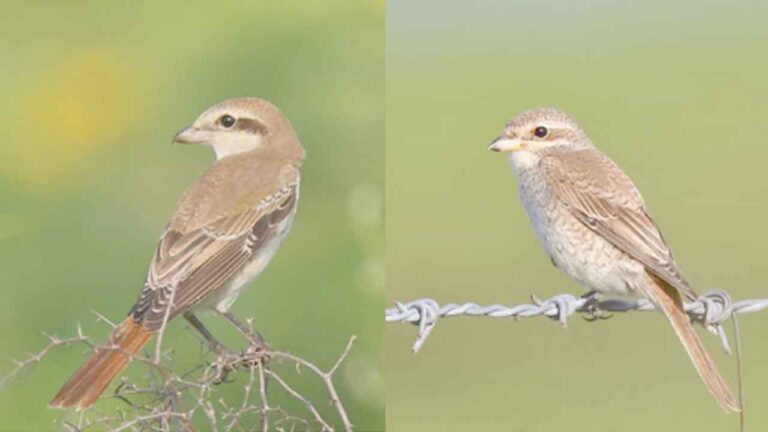
Dharamsala: In a significant ecological development, two rare species of migratory birds – the Red-tailed Shrike and the Red-backed Shrike – have been officially documented in Himachal Pradesh for the first time. Both birds were spotted and photographed in the Nagrota Surian section of the Pong Lake wetland area by Dr. Abhinav Chaudhary, a dermatologist at Zonal Hospital Dharamsala and an avid bird watcher.
Dr. Chaudhary first photographed the Red-tailed Shrike on September 13. Just a week later, on September 20, he spotted and recorded the Red-backed Shrike in the same scrub habitat. Identifying the two birds presented a major challenge as both were immature specimens.
Their appearance closely resembled the Isabelline Shrike (Lanius isabellinus), a species that commonly passes through the region during autumn migration. To establish an accurate identification, the photographs were sent to national and international ornithological experts for detailed analysis. Following their confirmation, both species were officially added to Himachal Pradesh’s avian record.
Migratory species like the Red-tailed Shrike (Lanius phoenicuroides) and Red-backed Shrike (Lanius collurio) typically breed across Europe, Siberia, and Central Asia before migrating toward Africa for the winter. Their traditional migration routes cover parts of western India and occasionally Ladakh.
The recording of both species in Himachal Pradesh is being viewed as a significant environmental development for the Pong Lake region. Ornithologists suggest this sighting points to the possibility that the wetland and its surrounding scrublands could be emerging as a new stopover route along a lesser-known migratory path across the north-western Himalayas.



However, the discovery has also brought attention to the pressure on local ecosystems. Shrikes rely heavily on open grasslands and scrub areas for feeding and resting. These habitats around Pong Lake face ongoing threats from agricultural expansion, plantations, and land conversion. Experts emphasize that preserving these remaining open ecosystems is crucial to sustaining the wide diversity of migratory and resident birds that depend on the Ramsar-designated wetland.