
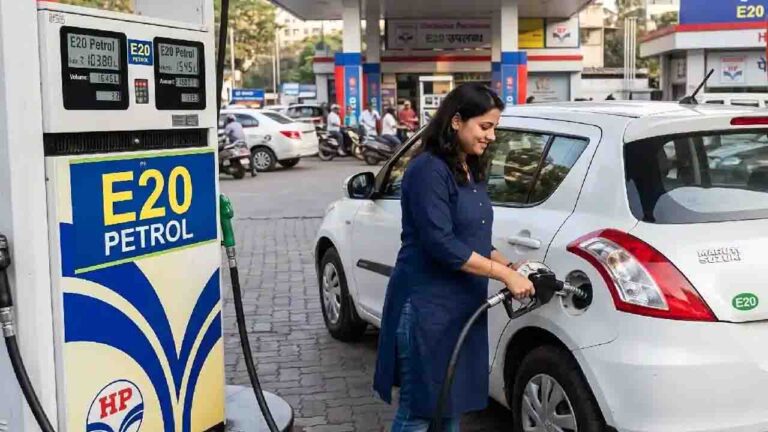

Amid widespread public anger over E20 petrol, the Central Government is evaluating whether high-octane branded fuels—such as XP95, Speed, and Power95—can be sold using an E10 formulation.
This move would eliminate the need to set up separate storage and dispensing infrastructure for E10, especially as many motorists are shifting to high-octane petrol after experiencing issues with standard E20 fuel.
E20 petrol contains 20% ethanol, whereas E10 contains 10%. India’s ethanol blending program began as a pilot initiative in 2001, followed by the introduction of E5 in 2006. Although blending stood at just 1.53% in 2013-14, it has grown consistently since.
Sources revealed to Mint that the Ministry of Petroleum is currently holding discussions with state-run oil marketing companies, including Indian Oil, Bharat Petroleum, and Hindustan Petroleum. The talks remain in their early stages, and no final decision has been made.
Despite government assurances, vehicle owners continue to express strong concerns regarding E20 petrol‘s adverse impact on engine durability and mileage in older vehicles.



In Kushinagar, a heated debate unfolded at a local tea stall over the issue. Businessman Govind Kasaudhan complained that his motorcycle’s fuel consumption has increased significantly. Meanwhile, textile merchant Rastogi shared that his car now requires frequent servicing. Driven by such worries, demands to reintroduce E10 petrol—which is considered better suited for older engines—have intensified over recent months.
“Options are being explored to offer E10 fuel for older vehicles and address public concerns. Supplying Octane 95, which comes at a premium, as E10 is one option under consideration,” a source stated.
A second source indicated that the government and oil companies are evaluating whether selling Octane 95 as E10 is commercially viable and acceptable to consumers, essentially creating a premium E10 offering.
Responding to recent remarks by Chief Economic Adviser V. Anantha Nageswaran, Singh noted, “Using the existing Octane 95 infrastructure, which currently has 20% ethanol, E10 petrol can be easily sold.”
Addressing Parliament, Union Minister for Road Transport and Highways Nitin Gadkari acknowledged that E20 petrol can cause a 2 to 6 percent drop in fuel economy, depending on the vehicle. However, in a written response to the Lok Sabha, Gadkari clarified that dynamometer engine durability tests and real-world vehicle testing showed no breakdowns caused by E20. He added that E20 provides better acceleration, improved ride quality, and roughly 30 percent lower carbon emissions compared to E10.
Currently, Octane 95 or ‘branded’ fuels like Indian Oil’s XP95, BPCL’s Speed, and HPCL’s Power95 retail at ₹110–115 per liter in Delhi, compared to standard petrol at ₹102 per liter.
A premium Octane 100 variant is also available for luxury cars at around ₹150–170 per liter. It contains zero ethanol and higher additive content.
At present, Octane 95 uses the same E20 blend as regular petrol but contains specific chemical additives that clean engine components, enhance combustion, prevent corrosion, and boost performance. It is currently available across 90,000 state-owned fuel stations.