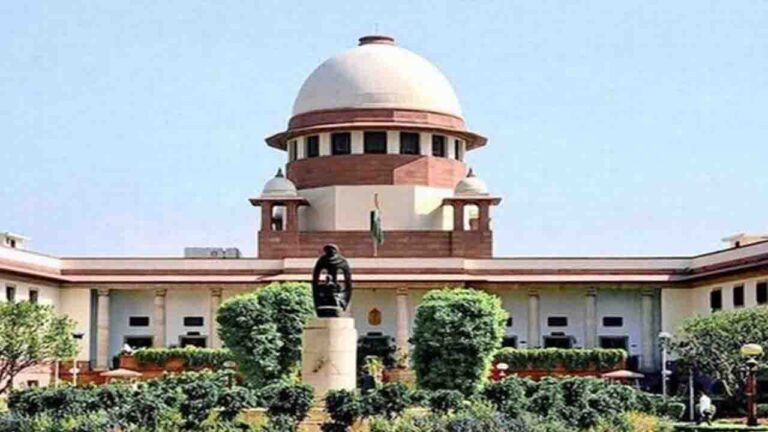

NEW DELHI: The Supreme Court has taken strong exception to alleged excessive force used by the police during recent student protests, observing that the mere occurrence of an agitation or demonstration at a location cannot justify lathicharge or disproportionate force.
The observations came while hearing a Public Interest Litigation (PIL) filed by petitioner Priya Mishra, through advocate Narendra Mishra, seeking a high-level inquiry into the police action against demonstrators at Jantar Mantar, terming it unjust. Prior to this, a letter on the issue was sent to the Chief Justice three days ago, but no action was taken on it, leading to the formal PIL filing.
A bench headed by Chief Justice of India (CJI) Surya Kant affirmed that the right to peaceful protest is a constitutional guarantee. The court stated that the Constitution fully protects the right to demonstrate peacefully, and it cannot be denied under any circumstances.
The CJI emphasized the need for a uniform national protocol and guidelines for conducting peaceful agitations across the country. The bench noted that people must have designated and proper spaces to express themselves democratically, which would also help authorities manage anti-social elements more effectively.
Police excesses during students’ protest | Supreme Court has said that the right to peaceful protest is a constitutional guarantee, that the mere existence of an agitation cannot justify alleged police excesses against demonstrators. A bench led by CJI Surya Kant also indicated… pic.twitter.com/PopB5NaPAk
Also Read— ANI (@ANI) July 27, 2026



During the proceedings, the apex court also expressed deep concern over attacks and violence directed at police personnel during demonstrations. When an advocate mentioned instances of wild crowds injuring police officers and targeting their families, Justice Joymalya Bagchi remarked that injuries to police personnel are equally a matter of serious concern. The bench added that the state government could be asked to explain why adequate security arrangements were not put in place.
Underlining that self-discipline is a critical component of public protests, CJI Surya Kant noted that while peaceful demonstrators should face no hindrance at designated spots, anti-social elements joining such crowds can be dealt with strictly. The court scheduled the matter for further hearing on Tuesday.
The PIL prays for a Writ of Mandamus directing authorities to immediately preserve and protect all digital and electronic evidence linked to the incident. This includes CCTV footage, police body-worn camera footage, drone recordings, mobile phone videos, social media posts, police wireless communications, call logs, control room records, police deployment orders, and GPS logs.
Expressing apprehension that these critical records could be destroyed, altered, or suppressed, the petitioner requested that they be secured and presented before an appropriate judicial or investigating authority. Additionally, the petition demands that if any public servant or police officer appears to have committed a cognizable offence based on available evidence, media reports, or official records, an FIR should be registered immediately to initiate a fair, independent, and time-bound criminal investigation.