
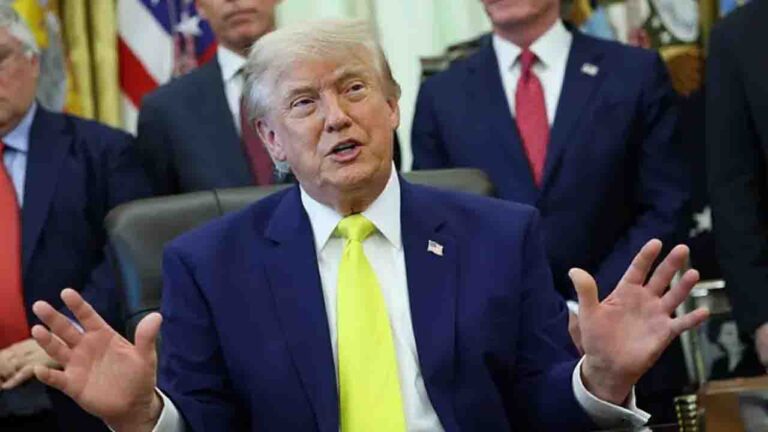
WASHINGTON: US President Donald Trump said Iran shot down an American helicopter over the Strait of Hormuz, prompting immediate US retaliatory strikes.
According to US Central Command (CENTCOM), the strikes began on Tuesday at 2:30 am Indian time in response to the downing of the helicopter. CENTCOM described the mission as “a proportionate response to Iran’s unprovoked aggression.”
One US official told CBS News, the BBC’s partner, that it was not clear whether the drone attack on the helicopter was intentional.
The two crew members aboard the downed Apache helicopter were rescued unharmed by a US sea-drone, Trump said on his Truth Social platform. “Both pilots are safe and have no injuries. Nevertheless, it was necessary for the United States to respond,” he wrote.
Trump told ABC News that the American response would be “very strong and very powerful” because Iran had brought down the US helicopter. In a phone interview, he reiterated that a response was “necessary” and should match the strength of the initial attack.



US officials told Axios that American forces targeted several Iranian defence and radar systems.
Iranian state television reported explosions and air defence activity along the Persian Gulf coast, including areas near Bandar Abbas, Qeshm, and Sirik.
Iran’s Response
Iranian Foreign Minister Seyed Abbas Araghchi reacted on X (formerly Twitter), saying the US was testing Iran’s resolve despite its losses. “Our powerful army will not leave any attack or threat unanswered,” he wrote, adding, “If you want to stay safe, leave our region.”
Controlled Exchange
Analysts described the incident as a tit-for-tat exchange rather than the start of a wider war. Firas Maksad, Managing Director of the Middle East and North Africa Eurasia Group, told the BBC that the US action was carefully calibrated, targeting only radar and military sites near the Iranian coast and the Strait of Hormuz.
“I don’t think there is an immediate risk of the war restarting on a large scale,” Maksad said. “This is a controlled confrontation. Neither side wants a big war again.”
He noted that Iranian leaders believe Trump has limited military options, while Trump has continued to tell Americans that a deal is only days away. According to Maksad, the US is maintaining economic pressure through sanctions, while Iran is playing a long game, testing American patience.
The developments come amid ongoing tensions between the two countries.