
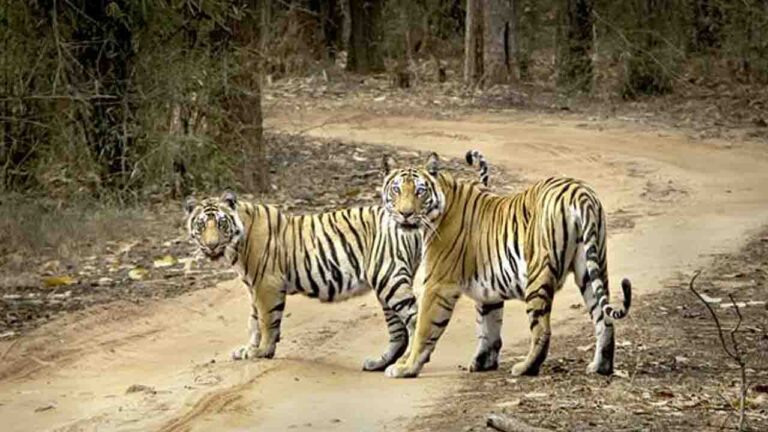
MP Tiger Population: Madhya Pradesh is witnessing an unprecedented surge in its tiger population, which is rapidly approaching the one thousand mark. This massive conservation success has now sparked severe concerns regarding shrinking habitats, limited prey, and rising wildlife conflicts, prompting top officials to completely reassess forest capacity.
Over the last decade, Madhya Pradesh has outpaced the national average in tiger conservation. While India saw a 65% increase in its tiger population from 2014 to 2022, Madhya Pradesh recorded a staggering 155% jump, growing from 308 to 785 big cats. State officials confirm this rapid upward trend continues today.
However, this booming population has brought a new set of challenges. The state government has urgently reached out to the Wildlife Institute of India (WII) in Dehradun to evaluate the exact carrying capacity of its forests. As tiger numbers grow, so does the dangerous overlap with human settlements.
Across India, human fatalities from tiger attacks have spiked drastically. Fatalities jumped by 87%, rising from 224 deaths between 2014 and 2019 to 418 in the subsequent 2020-2025 cycle. In retaliation, instances of villagers electrocuting tigers to protect their livestock have also seen a troubling increase.
Experts point out that a forest’s capacity to host tigers relies heavily on its prey base. Dr. Rajesh Gopal notes that a single tiger requires roughly 350 hoofed animals, like deer, every year to survive. When a forest exceeds its carrying capacity, excess tigers are forced into buffer zones or end up fighting for territory.



According to media report Wildlife biologist Milind Pariwakam explains that aggressive infrastructure development—including roads, railways, and mining—has fragmented Central India’s natural wildlife corridors. Dispersing tigers are no longer able to migrate safely between forests, directly leading to an increase in deadly human-animal encounters.
This lack of wild prey and natural space is actively changing tiger hunting behaviors. A recent study in Madhya Pradesh revealed that domestic livestock now makes up nearly 47% of the diet for tigers in the Bandhavgarh Tiger Reserve. Similar trends have been documented in Rajasthan’s Ranthambore and Sariska reserves.
A senior forest official noted that the ban on cow slaughter has naturally increased the stray cattle population. While these cattle provide an easy food source that sustains tiger numbers inside the reserves, tigers that wander outside to hunt them face massive risks of poisoning or electrocution by angry locals.
According to media report WII Director Dr. Gobind Sagar Bharadwaj emphasizes that restoring grasslands to boost the natural wild prey base is the ultimate solution. Experts advise against relocating tigers to degraded forests, suggesting instead that habitats across Madhya Pradesh, Jharkhand, and Odisha be actively restored to safely accommodate the growing numbers.
Meanwhile, human encroachment continues to threaten these vital ecosystems. In a recent development, forest officials at the Panna Tiger Reserve issued a notice to an IRS officer and his wife for allegedly constructing a commercial resort right inside the reserve’s ecologically sensitive zone.