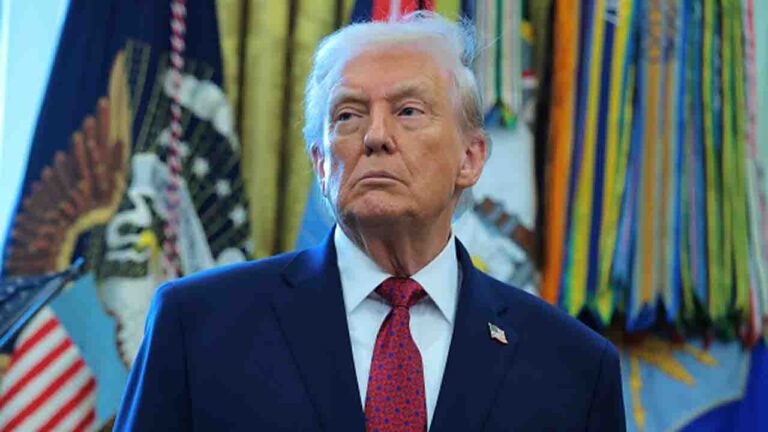

WASHINGTON: U.S. President Donald Trump has significantly escalated global trade frictions by threatening to impose a 25% tariff on cars and trucks imported from the European Union (EU). Taking to his Truth Social platform on Friday, Trump accused the European bloc of failing to adhere to the terms of a previously established trade agreement, signaling a major shift in transatlantic economic policy.
The proposed hike marks a substantial jump from the 15% tariff rate fixed on EU automobiles and parts during an agreement reached last summer. While the earlier 15% rate was notably lower than the 25% duty applied to other trading partners, the President has now indicated that the era of preferential treatment may be ending.
The new tariffs are expected to be implemented as early as next week. While the announcement focused on trade compliance, it arrives on the heels of a sharp diplomatic exchange.
Only a day prior, Trump had publicly criticized German Chancellor Friedrich Merz, urging the leader to focus on ending the Ukraine conflict rather than intervening in matters related to Iran. Given that Germany remains the EU’s premier automobile exporter, these tariffs are poised to hit the German economy particularly hard.
The European Union has been actively seeking to stabilize trade relations with Washington. In April, EU trade chief Maros Sefcovic engaged in high-level discussions with U.S. officials, including Commerce Secretary Howard Lutnick, regarding steel tariffs. However, the latest threat jeopardizes these diplomatic efforts.



The U.S. remains the second-largest market for EU vehicle exports after the United Kingdom, accounting for over one-fifth of total shipments. The stakes are exceptionally high for Berlin. According to the VDA industry group, Germany exported approximately 4.5 lakh vehicles to the U.S. in 2024.
Although export volumes have seen a slight decline recently, a jump to a 25% duty could stifle one of Europe’s most vital industrial sectors, further straining the relationship between the Trump administration and the Merz-led German government.