
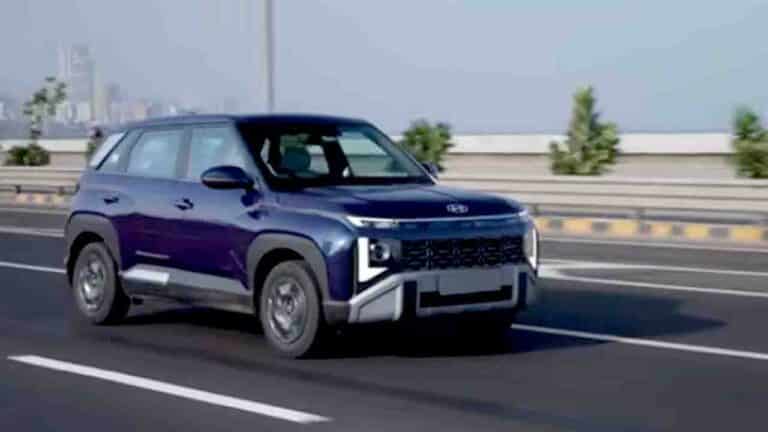
The Hyundai Venue compact SUV comes with three different engine options for buyers. These include a 1 L turbo petrol, a 1.5 L diesel, and a 1.2 L naturally aspirated petrol engine. Both the turbo petrol and the diesel engines can be bought with either a manual or an automatic transmission. On the other hand, the 1.2 L petrol engine is solely offered with a single 5-speed manual gearbox. Surprisingly, despite this limited mechanical offering and the complete absence of an automatic option, this specific 1.2 L petrol engine accounts for over 60% of total Hyundai Venue sales.
This 83 horsepower, 1.2 L naturally aspirated petrol engine is a very familiar unit in India. It already does duty on all the smaller Hyundai cars, including the Grand i10 Nios, the Aura, the Exter, and the i20. Hyundai has done a commendable job as far as the sound insulation goes inside the cabin. Drivers can barely hear the engine when it is running at low and mid revs. Even in a larger vehicle like the Venue, this engine feels adequately peppy. It remains highly responsive and will keep up with daily city traffic with absolute ease. Quite honestly, as a point A to point B city commuter with an occasional highway drive with the family once in a few months, this version of the Venue does the job perfectly fine.
To easily compensate for the added weight of the vehicle over the smaller Exter or Grand i10 Nios, the engineering team has made the Venue’s gearing much shorter. As a direct payoff, the overall drivability is really impressive. Not only are the part-throttle responses quite crisp in daily use, but even when you put your foot down completely, its rolling acceleration times are highly competitive. The acceleration from 20 to 80 km/h in third gear and from 40 to 100 km/h in fourth gear is actually quicker than both the Nios and the Exter.
Outright performance, though, is far from impressive. This car takes over 15 seconds to accelerate from 0 to 100 km/h, which is not something regular owners would really bother about too much. However, if you are an automotive enthusiast and you love revving out this motor, you will certainly be left yearning for more performance. The power delivery tapers down quite sharply beyond 5,000 RPM. From there on, the engine just sounds boomy, creating more noise inside the cabin than actual forward progress. Of course, if you are an enthusiast, you always have the option of choosing the more powerful turbo petrol engine instead.
Something that most prospective buyers will be highly interested in is its real-world fuel efficiency. When put through real-world tests, the Venue delivered rather respectable numbers of around 10.7 km per liter in the city. You might think that this fuel efficiency is a bit on the lower side for a manual car, but you need to factor in two specific things. First, it does not get an automatic engine stop-start function.



Therefore, when you are idling in heavy traffic, the engine will remain completely on and fuel is not being saved. The second thing is that while cruising at highway speeds, its engine is spinning at a high 3,200 RPM at 100 km/h in top gear, which also hampers its highway fuel efficiency. If you are strictly looking for a car that is more fuel efficient, you should consider a Maruti Fronx or a Toyota Taisor 1.2 petrol instead.
The Venue’s buttery smooth 5-speed manual gearbox and light clutch make driving this car around in crowded cities quite effort-free. Even its steering is very light, making the car feel extremely user-friendly. However, it would be preferred if the steering weighed up a bit more at cruising speeds, as it just feels a bit too light and too lifeless on highways. The handling itself is predictable and neutral, which is exactly what you would expect from a city-friendly family compact SUV.
This version of the Venue rides on smaller 15-inch wheels. As a result, you do not feel those sharp-edged potholes as much as you do in the more premium versions equipped with larger 16-inch wheels. That said, the suspension setup does not exude that tough or butch feeling that you can easily experience with rivals like the Maruti Brezza, Tata Nexon, Mahindra XUV 3XO, as well as the Skoda Kylaq.
This second-generation Venue has only slightly grown in terms of its overall size. It is a bit wider than before, and its wheelbase too is a bit longer. However, it feels a lot bigger and a lot more grown up from behind the wheel. What you are likely to appreciate is the fact that you are seated high up. Visibility outside is very good and you also have the front bonnet clearly in your field of vision. It successfully delivers that classic SUV drive experience with a commanding driving position.
The dual-tone color scheme adds to the cabin’s general airiness, and the use of black for the seat bases and regular touchpoints is a sensible choice to keep the cabin looking clean over time. The curved housing for the touchscreen and the digital instrument cluster also elevates the cabin’s premium appeal. Appreciably, Hyundai has retained plenty of physical buttons and knobs for controls, while thoughtfully designed storage spaces add to the practicality quotient. Seat comfort in both rows is largely good. While the cabin and boot space are generous, they are broadly in line with what rivals offer.
In the mid-spec S(O) variant, the Venue almost appears hatchback-like due to the absence of roof rails, which unfortunately takes away some of that visual height and SUV stance. The 195/65 R15 tires also do not fill up the wide wheel arches quite as nicely as the chunkier 215/60 R16 tires available on the top-tier turbo petrol and diesel variants. Interestingly, none of the 1.2 L petrol variants get alloy wheels from the factory. Instead, 15-inch steel wheels with plastic covers are standard across the entire 1.2 L range. That said, other design elements such as the oversized L-shaped LED DRLs, contrasting silver C-pillar garnish, body cladding, shark fin antenna, and distinct tail lamps add plenty of character to the styling.
Coming to the variants and pricing, the 1.2 L version is available across five distinct variants. The starting price begins at Rs 8 lakh and goes all the way up to Rs 10.88 lakh. The mid-spec variant driven for this review is the S(O), which is priced at Rs 9.5 lakh. For the money, you get a lot of features, including a sunroof, twin screens with wireless Android Auto and Apple CarPlay, a tire pressure monitoring system, and electrically folding mirrors.
However, when you view it directly against its market rivals, the Venue does not come across as exceptional value. The 1.2 L petrol range is priced between Rs 8 lakh and Rs 10.88 lakh. For similar money, rivals like the Tata Nexon, Skoda Kylaq, and Mahindra XUV 3XO offer more powerful turbo petrol engines paired with superior 6-speed manual gearboxes. Not only are those rivals noticeably quicker, but they are also far more engaging to drive.
Yes, this 1.2 L engine is definitely not for the driving enthusiast. Furthermore, not having an automatic transmission option is a bit disappointing, especially when you take into account that the premium i20 hatchback is available with the exact same engine paired with a smooth CVT transmission. Having that automatic gearbox would have really completed the Venue 1.2 L package for city buyers.
However, as things stand, the Hyundai Venue remains a very well-rounded compact SUV. Ultimately, it is not hard to see why this specific version sells in such high numbers across India. It successfully ticks all the right boxes for a regular buyer. It is smooth and easy to drive, the interior is spacious and quite comfortable, it comes well equipped with modern features, and quite honestly, it does the job. As a city-friendly family car, it is about as good as it gets.