
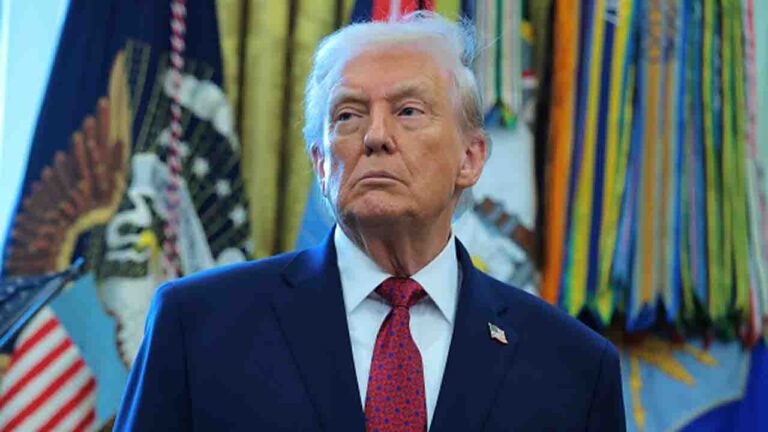
President Donald Trump has made a firm declaration regarding the United States’ stance on Iran, asserting that the prevention of a nuclear-armed Tehran is his absolute priority. Speaking on Tuesday, the President emphasized that the economic hardships currently faced by American citizens would not dictate or soften his approach to negotiations.
When asked by a reporter at the White House whether the financial situation of Americans was motivating him to reach a quick settlement to the war, Trump responded bluntly, “Not even a little bit.” The statement comes at a time of heightened tension, as the administration seeks to navigate a complex geopolitical landscape.
Before departing for his official visit to China, the President clarified his singular focus. He stated that when discussing Iran, the only thing that truly matters is ensuring they never possess a nuclear weapon. He further remarked that he is not focused on the financial situation of individuals but is solely driven by the goal of nuclear non-proliferation.
“I don’t think about Americans’ financial situation. I don’t think about anybody. I think about one thing: we cannot let Iran have a nuclear weapon. That’s all. That’s the only thing that motivates me,” Trump told the gathered media. These comments underscore a rigid foreign policy stance that places national security far above domestic economic indicators.
The President’s remarks have immediately drawn intense scrutiny from political analysts and critics. Many argue that a balanced approach is necessary, especially as the American public grapples with the rising cost of living. There is an ongoing debate about whether the administration should weigh geopolitical goals against the immediate economic impact on the electorate.



The timing of these statements is particularly sensitive. The United States is moving toward crucial midterm elections in November, where inflation and the cost of basic goods are expected to be the primary concerns for voters. Critics suggest that ignoring these factors could lead to significant political repercussions for the ruling party.
Addressing the President’s comments, White House Communications Director Steven Cheung defended the stance. He stated that the President’s ultimate responsibility is the safety and security of all American citizens. Cheung noted that a nuclear-armed Iran would pose a direct threat to the nation, justifying the current administrative focus.
However, the pressure is not only coming from the opposition. Several of Trump’s Republican allies have expressed growing concern over the situation. They fear that the economic strain caused by the prolonged conflict could lead to a public backlash. There are internal worries that this could result in the loss of control over the House of Representatives and the Senate.
Despite these domestic political and economic pressures, the President remains steadfast. He reiterated that the global threat of a nuclear Iran outweighs temporary financial discomfort. As the administration continues its diplomatic and military maneuvers, the impact on both global security and the American wallet remains a central point of contention.