
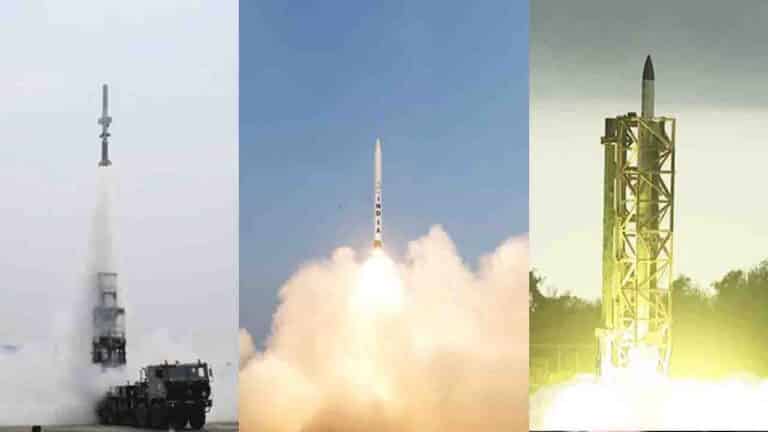
NEW DELHI: In a decisive step toward securing its skies, the Defence Research and Development Organisation (DRDO) on Friday successfully executed three consecutive flight tests, showcasing a next-generation multi-layered Ballistic Missile Defence (BMD) shield and debuting a brand-new medium-range Naval Anti-Ship Missile.
Announcing the milestone, Defence Minister Rajnath Singh confirmed that the successful trials validate India’s capability to counter multiple categories of aerial threats, including long-range hostile missiles.
By successfully completing these complex tests, India has effectively broken into an elite global club. Only a handful of nations, including the United States, Russia, Israel, and China, possess the highly advanced technology required to intercept and destroy high-speed ballistic threats before they strike.
The three back-to-back tests targeted two entirely different strategic threats: the skies and the seas.
First, DRDO validated its Phase-II BMD architecture. This system uses specialised interceptor missiles to track, lock onto, and destroy incoming enemy ballistic missiles mid-flight.



Second, the trials debuted the Naval Anti-Ship Missile-Medium Range (NASM-MR). This completely indigenous weapon system is designed for the Indian Navy, allowing Indian warships to strike hostile surface vessels from safe, medium-range distances. This vastly improves naval deterrence in critical maritime zones like the Indian Ocean.
Standard air defence networks, like Israel’s Iron Dome, are built to stop low-altitude, short-range rockets. In contrast, a BMD shield operates on a completely different scale, tackling massive, ultra-fast missiles that travel through the upper limits of the Earth’s atmosphere.
India’s defence shield uses a two-tier mechanism to create an unbreachable wall:
The Outer Space Layer: Designed to hit an incoming missile while it is still traveling in space, hundreds of kilometers above the Earth. Destroying a threat here ensures that dangerous debris or payloads burn up harmlessly far away from human populations.
The Atmospheric Layer: If an enemy missile somehow slips past the outer space interceptor, this secondary defensive layer activates inside the Earth’s atmosphere to engage and neutralise the target before it reaches its destination.
While India’s earlier Phase-I shield focused on protecting major metropolitan areas like New Delhi and Mumbai, this advanced Phase-II technology broadens the safety umbrella. It allows the military to intercept much faster, long-range threats at distances up to 5,000 kilometers away.
Modern air security relies on an integrated, domestic supply chain. DRDO’s triple-test victory proves that India no longer relies on foreign suppliers for critical security tech. The entire architecture operates via an interconnected network of home-grown tracking radars, automated command centers, and precision-guided interceptors.
Defence Minister Rajnath Singh emphasised that this successful demonstration directly upgrades national defence preparedness, giving India a decisive capability to protect its sovereignty against emerging regional security challenges.