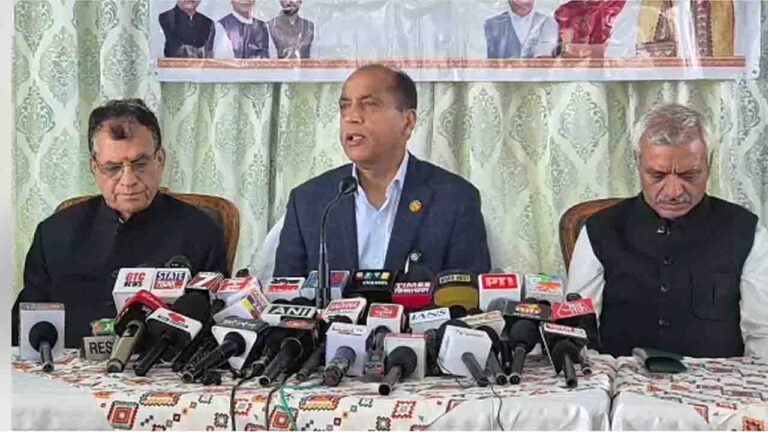

SHIMLA: Former Himachal Pradesh Chief Minister and Leader of Opposition Jairam Thakur launched a blistering attack on Chief Minister Sukhvinder Singh Sukhu and his administration, alleging that development work in the state has come to a standstill while the government operates purely out of political vendetta.
Addressing a press conference in Shimla, Thakur said that while the Congress government is approaching the completion of nearly four years in power, its track record remains limited to shutting down institutions and harassing opposition leaders.
He claimed that a “negative administrative culture” has taken root under Sukhu’s leadership. Referring to the recent local body and Panchayati Raj election results, Thakur noted that BJP candidates were elected unopposed as chairs and vice-chairs in 9 out of 10 districts, proving that the public has made up its mind to vote Congress out. Frustrated by declining popularity, the government is trying to silence critical voices, he added, calling Himachal a “Badlapur” (land of revenge).
False Cases Against BJP Leaders and Abuse of Probe Agencies
The Leader of Opposition alleged that for the first time in the state’s history, criminal cases are being systematically slapped on elected representatives, MLAs, and senior leaders.
He highlighted the cases of BJP State President Dr. Rajiv Bindal, former minister Sukhram Chaudhary, Dharamshala MLA Sudhir Sharma, along with former MLAs Hoshiar Singh, Ashish Sharma, Ravi Thakur, and Devinder Bhutto. Thakur accused the state administration of misusing vigilance and investigative agencies against them, asserting that despite clear, unbiased probe reports, fresh teams were formed under pressure from the CM to audit their homes and properties.



Allegations of Phone Tapping and Administrative Paralysis
Thakur further alleged that the police and administrative machinery have been crippled. Instead of appointing a full-time Chief Secretary and Director General of Police (DGP), the administration is running on temporary arrangements. He charged that despite Supreme Court directives, the state has not submitted the DGP panel to the Centre, solely to keep preferred officers in charge.
Furthermore, Thakur claimed that location tracking via GPS and PSOs, along with late-night phone tapping of opposition MLAs and leaders, is being carried out by senior officers. He cautioned officials violating rules under government pressure that strict legal action would follow once the political guard changes in the state.
Opposition Prepares Charge Sheet Ahead of Monsoon Session
The senior BJP leader announced that the party is compiling a detailed charge sheet to expose government corruption, deteriorating law and order, and administrative lapses. Expressing concern over rising crime, including recent murders in Shimla and a shooting incident in Bilaspur, Thakur stated that the BJP will corner the government in the upcoming Assembly monsoon session on issues of corruption, drug abuse, and governance.
He pledged that upon returning to power, the BJP would quash all politically motivated cases in its very first Cabinet meeting.
Internal Strife and the Rajani Patil Report
Taking a swipe at internal Congress dynamics, Thakur claimed widespread resentment within the ruling party. Citing a report reportedly submitted to the Congress high command by senior leader Rajani Patil, Thakur claimed it raised critical questions about the Chief Minister’s functioning, suggesting that the leadership must “either change the CM or change his style of working.”
Thakur remarked that while the Chief Minister speaks of long-term survival in public, his focus remains on eliminating internal political rivals. “He has already cleared out many, and efforts are underway to sideline the rest,” Thakur remarked, pointing out a growing rift between the Congress organization and the government.
Bureaucratic Discontent and Extension Favoritism
Thakur also alleged that senior officers are feeling suffocated under the current regime, with several approaching him directly requesting central deputation due to a toxic work environment.
He criticized the administration for granting extensions to favored officers-some facing corruption allegations-despite earlier public assurances that no extensions would be awarded. This double standard, he claimed, has severely disrupted the state’s administrative apparatus.