
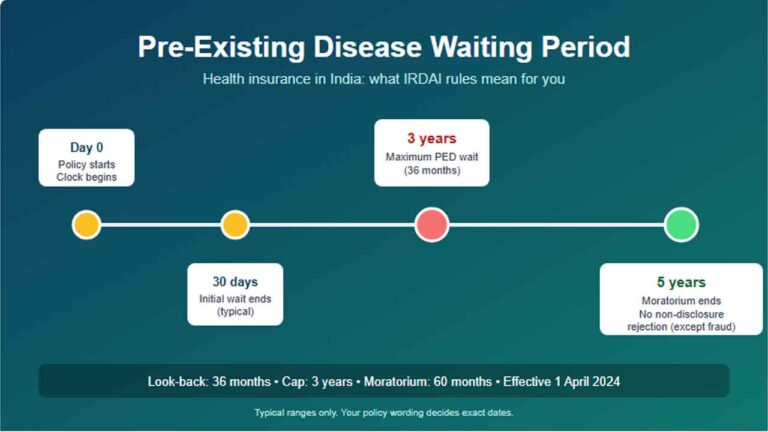
The pre-existing disease waiting period in health insurance is capped at 3 years under current IRDAI rules. If you keep your policy active for 5 years without a break, insurers generally cannot reject a claim for non-disclosure, except in proven fraud. You can still buy cover if you have diabetes, high blood pressure or a thyroid condition, but you must be honest on the proposal form and know exactly when each clause begins to apply.
Table of contents
- What is a pre-existing disease?
- How long is the pre-existing disease waiting period?
- The four waiting periods you will meet
- IRDAI’s 3-year cap and 5-year moratorium
- A worked timeline
- Does porting reset your waiting period?
- Premium loading: will you pay more?
- Group policy vs individual policy
- Why claims get rejected
- What to do if your claim is rejected
- A 7-point checklist before you buy
- FAQs
1. What is a pre-existing disease?
A pre-existing disease (PED) is any condition, illness or injury that was diagnosed, treated or medically advised before your health policy began. Under the current framework, insurers look back 36 months before the policy start date. Until March 2024 that window was 48 months.
Typical examples:
- Type 2 diabetes
- Hypertension (high blood pressure)
- Thyroid disorders
- Asthma
- Heart conditions
- Kidney or liver conditions
The key phrase is treated or advised. If a doctor told you to take medicine, get tests or follow up for a condition inside that window, treat it as pre-existing, even if you feel fine today.
2. How long is the pre-existing disease waiting period?
The maximum is 36 months (3 years), counted from the day your policy starts. No insurer can make you wait longer for a pre-existing condition. Many insurers offer shorter waits, and some plans let you reduce the wait by paying an extra premium.



This is a ceiling, not a fixed number. The period your insurer actually applies is printed in the policy wording, so always check it before paying.
3. The four waiting periods you will meet
Many buyers confuse these, so keep them apart.
| Waiting period | Typical length | What it blocks |
|---|---|---|
| Initial waiting period | Usually 30 days | Most illnesses (accidents are usually exempt) |
| Specific disease waiting period | Often 1 to 2 years (varies by plan) | Named conditions such as cataract, hernia, joint replacement |
| Pre-existing disease waiting period | Up to 3 years (maximum) | Conditions that existed before you bought the policy |
| Maternity waiting period | Often 9 months to 4 years, depending on the plan | Delivery and related costs |
The durations above are typical ranges, not guarantees. Your policy wording decides the actual dates.
4. IRDAI’s 3-year cap and 5-year moratorium
Two rule changes matter most, and both took effect on 1 April 2024:
a) PED waiting period capped at 36 months. Earlier it could run up to 48 months.
b) Moratorium reduced from 8 to 5 years. After 60 months of continuous coverage, an insurer cannot contest a policy or claim on grounds of non-disclosure or misrepresentation, except in proven fraud. Continuous years with a previous insurer count if you ported your policy.
Other points reported around these changes:
- The upper age limit for buying standard health cover was removed.
- Reports indicate that a condition first diagnosed within three months of buying a policy is no longer treated as automatically pre-existing. Insurers implement wording differently, so confirm with your insurer in writing.
5. A worked timeline
This example is illustrative. The dates are hypothetical.
Rohit, 42, has had diabetes for four years. He buys a policy on 1 January 2027.
| Date | What happens |
|---|---|
| 1 Jan 2027 | Policy starts. Rohit declares diabetes honestly. |
| 30 Jan 2027 | Initial 30-day wait ends. Most new illnesses become claimable. |
| 1 Jan 2029 | If his plan has a 2-year wait for cataract, that condition becomes claimable. |
| 1 Jan 2030 | 3-year PED wait ends. Diabetes-related hospitalisation is now claimable. |
| 1 Jan 2032 | 5-year moratorium completes. Non-disclosure disputes generally cannot be raised, except for fraud. |
Lesson: the clock starts on the day you buy. Every month you delay buying adds a month to your total wait.
6. Does porting reset your waiting period?
Portability lets you move to another insurer without starting from zero. Under IRDAI rules, the waiting period you have already served should be credited. For example, if your old policy has completed 24 months and the new insurer’s maximum for that condition is 36 months, you should need to wait only about 12 more months.
Practical points:
- Apply well before your renewal date, and check your insurer’s exact deadline.
- Disclose all conditions to the new insurer and be ready to share medical records.
- Credit applies to the sum insured you already had. If you increase the cover, waiting periods may apply to the extra amount.
- Keep the old policy active until the new insurer confirms acceptance in writing.
If continuity is maintained and there is no wilful fraud, insurers should not reject a claim on purely technical grounds after porting.
7. Premium loading: will you pay more?
Sometimes. With “loading”, the insurer adds a percentage to your premium for a known condition. In return it may cover you sooner or with fewer restrictions. Whether loading is offered, and at what rate, depends on the insurer and your medical reports.
Loading can be worth considering if your condition is likely to lead to hospitalisation, or if the full 3-year wait would leave you exposed.
8. Group policy vs individual policy
Group policies from employers may waive the pre-existing disease waiting period, especially for larger groups, but this is not universal. Two cautions:
- Group cover usually ends when you leave the job.
- A personal policy bought later starts its own waiting periods.
If you are in your 30s or 40s, consider buying a personal policy while you are healthy, even if your employer covers you. It starts your waiting periods running in the background.
9. Why claims get rejected
Claim rejection is rarely random. Common reasons include:
- Non-disclosure or misrepresentation. Leaving out diabetes, surgeries or habits such as smoking.
- Claim during a waiting period. For example, a knee replacement in year one.
- Policy lapsed. Premium was paid late and the grace period ended.
- Excluded treatment. Cosmetic procedures, and some dental or infertility treatments, unless specifically covered.
- Missing or incorrect documents.
- No pre-authorisation for a cashless request, or treatment at a non-network hospital.
- Room-rent or sub-limit rules. A costlier room can reduce the payable amount proportionately.
- Hospital stay too short where the plan requires 24 hours, except listed day-care procedures.
Insurance complaints in India crossed 2.5 lakh in FY 2024-25, and roughly half were claim-related. Knowing these rejection points in advance is your best protection.
10. What to do if your claim is rejected
- Ask for the rejection reason in writing.
- Check it against your policy wording.
- Send missing documents if it is a paperwork issue. The hospital’s insurance desk can help.
- Write to the insurer’s Grievance Redressal Officer (GRO).
- Escalate through the IRDAI’s Bima Bharosa complaint portal.
- Approach the Insurance Ombudsman if the issue is still unresolved.
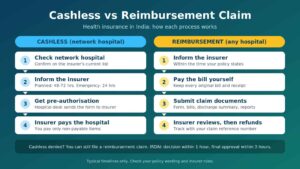
Keep copies of the policy, premium receipts, medical records, bills and all emails. A cashless rejection is not always final: if treatment was at a non-network hospital, you can still file a reimbursement claim.
11. A 7-point checklist before you buy
- [ ] I have listed every diagnosis and treatment from the last 3 to 4 years.
- [ ] I have read the exact PED and specific-disease waiting periods.
- [ ] I have compared waiting periods and room-rent rules, not only the premium.
- [ ] I know whether loading applies and what it costs.
- [ ] I have checked the insurer’s network hospitals near me.
- [ ] I have set an auto-renewal reminder so the policy never lapses.
- [ ] I have saved a soft copy of the policy, proposal form and all medical reports.
12. FAQs
What is the pre-existing disease waiting period in health insurance?
It is the time you must keep the policy active before claims for conditions that existed before purchase are payable. IRDAI’s maximum is 3 years.
Can I buy health insurance if I already have diabetes or BP?
Yes. Most insurers offer cover, usually with a waiting period and sometimes a higher premium.
What is the moratorium period in health insurance?
Sixty months of continuous cover, after which claims generally cannot be denied for non-disclosure, except in proven fraud.
Does the waiting period restart if I renew late?
A lapse can break continuity and may lead to fresh waiting periods. Renew before the grace period ends and confirm terms with your insurer.
Will my parents’ policy cover their existing illnesses?
It depends on the plan. Check the PED waiting period, sub-limits and co-payment clauses.
Can hiding a condition really cancel my claim?
Yes, if the insurer proves material non-disclosure inside the moratorium window. After 60 months of continuous cover the rules favour you unless fraud is proven.
Should I wait until I am healthier to buy?
Usually no. Each month of delay adds to your total wait, and a new diagnosis can make cover harder or costlier.
This article is general information based on IRDAI rules and insurer disclosures available as of September 2026. It is not medical, legal or financial advice. Policy terms differ, so read your policy wording or speak to a licensed adviser.