
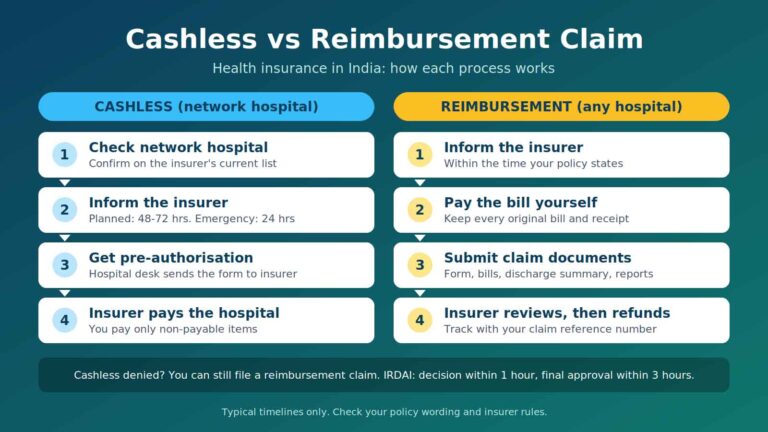
Cashless vs Reimbursement Health Insurance Claim: In a cashless claim, your insurer pays the hospital directly, and you pay only for items your policy does not cover. In a reimbursement claim, you pay the bill first and then apply to the insurer for a refund. Cashless works at network hospitals. Reimbursement works anywhere. The difference that matters most is timing: missing an intimation deadline or a document can delay or reduce your payout, so it helps to know the process before someone is admitted.
Table of contents
- Cashless vs reimbursement at a glance
- When to choose which
- Cashless claim: step by step
- IRDAI’s 1-hour and 3-hour rules
- Reimbursement claim: step by step
- Documents checklist
- Deadlines you must not miss
- Why the final bill may still be higher than expected
- If your cashless request is rejected
- If your claim is rejected: how to escalate
- Common mistakes
- Keep this ready at home
- FAQs
1. Cashless vs reimbursement at a glance
| Cashless | Reimbursement | |
|---|---|---|
| Who pays the hospital? | Insurer, directly | You, at discharge |
| Where it works | Network hospitals only | Any hospital, network or not |
| Upfront money needed | Usually only non-payable items | Full bill (until refunded) |
| Paperwork | Mostly handled by the hospital’s insurance desk | You collect and submit documents |
| Pre-approval | Required (pre-authorisation) | Intimation required, no approval before treatment |
| Speed of money | Settled between insurer and hospital | Refund comes after review |
| Best for | Planned surgery, emergencies at network hospitals | Non-network hospital, or after a cashless denial |
2. When to choose which
- Choose cashless if the hospital is on your insurer’s current network list. It protects your savings and reduces paperwork during a stressful time.
- Choose reimbursement if you must use a non-network hospital, if you are treated while travelling, or if you prefer a particular doctor who is not in the network.
- Reimbursement is your safety net. A rejected cashless request does not mean the claim is over.
3. Cashless claim: step by step
Planned treatment (for example cataract, knee replacement, planned surgery):
- Confirm the hospital is in the network. Check the insurer’s website or app, not only the hospital’s word.
- Inform the insurer or TPA before admission. Most insurers ask for 48 to 72 hours’ notice, though some accept less. Check your policy.
- Submit the pre-authorisation form at the hospital’s insurance desk. The doctor fills in the diagnosis, treatment plan and estimated cost.
- Wait for approval. The insurer sends an authorisation letter to the hospital.
- Get admitted, get treated. At discharge, the insurer’s final authorisation is issued and the hospital settles with the insurer.
- Pay non-payable items (see section 8) and collect copies of all papers.
Emergency:
- Go to the hospital first. Never delay care to sort out paperwork.
- Show your health card or policy number and an ID proof at the insurance desk.
- Make sure the insurer is informed within 24 hours of admission (or before discharge for short stays). The hospital usually does this, but confirm.
- Follow up on the authorisation and keep the reference number.
4. IRDAI’s 1-hour and 3-hour rules
In its health insurance Master Circular of 29 May 2024, IRDAI set time limits for cashless claims. In short:
- Insurers must decide on a cashless authorisation request within one hour of receiving it.
- Insurers must give final authorisation within three hours of the hospital’s discharge request.
- The circular says the policyholder should not be made to wait for discharge. If a delay goes beyond three hours, the extra hospital charges are to be borne by the insurer from its shareholders’ funds rather than passed on to you.
- For claim settlement, insurers and TPAs are expected to collect required documents from the hospital instead of asking the policyholder to run around.
- Insurers were asked to put the needed systems in place by 31 July 2024, and to display their hospital networks and claim procedures clearly.
- Ombudsman awards must be implemented within 30 days, with a penalty of ₹5,000 per day payable to the policyholder for delay.
What this means for you: ask the hospital’s insurance desk when the request was sent, note the time, and escalate if the limits are crossed. These are regulatory timelines, and real-world delays can still happen, so keep a record.



5. Reimbursement claim: step by step
- Inform the insurer about the admission. Emergency: as soon as possible, and within the time in your policy (often 24 to 48 hours). Planned: usually 48 to 72 hours before.
- Pay the hospital bill at discharge and collect original documents.
- Fill in the claim form (available on the insurer’s app or website).
- Submit the documents within the deadline in your policy.
- Respond to queries. Insurers may ask for extra records.
- Track the claim using the reference number until it is settled or you get a written reason for denial.
6. Documents checklist
Keep originals and take photos of everything.
- Filled and signed claim form
- Policy copy or health card and ID proof
- Hospital bills with a breakup (room, doctor fees, medicines, tests)
- Payment receipts
- Discharge summary
- Doctor’s prescriptions and advice
- Investigation and diagnostic reports
- Pharmacy bills with prescriptions
- Implant stickers or invoices, if any were used
- Bank details or cancelled cheque
- FIR or medico-legal certificate (for accidents, if applicable)
- Post-hospitalisation bills and follow-up reports, when claiming those
7. Deadlines you must not miss
Insurers differ, so use these as typical ranges and confirm in your policy.
| Situation | Typical timeline |
|---|---|
| Cashless, planned | Inform 48 to 72 hours before admission |
| Cashless, emergency | Inform within 24 hours of admission |
| Reimbursement, planned | Intimation before admission (often 48 hours) |
| Reimbursement, emergency | Intimation within 24 to 48 hours |
| Reimbursement documents | Often within 7 to 15 days of discharge in practice; formal limits are commonly around 30 days for hospitalisation and 15 days for post-hospital expenses |
| Cashless approval letter | Often valid for a limited period (for example about 15 days), so do not delay admission |
Filing early is always safer than testing the limit.
8. Why the final bill may still be higher than expected
Even with cashless, you may pay some amount yourself:
- Non-payable items: Consumables such as gloves, some registration or admission charges, and items not covered by your policy.
- Room rent limit: If your policy has a cap and you choose a costlier room, many policies reduce doctor fees and other charges proportionately, not just the room difference.
- Sub-limits: Caps on specific treatments, such as cataract or certain surgeries.
- Co-payment: A fixed percentage of the bill that you pay, common in some senior citizen plans.
- Deductibles: An amount you pay before the insurer starts paying.
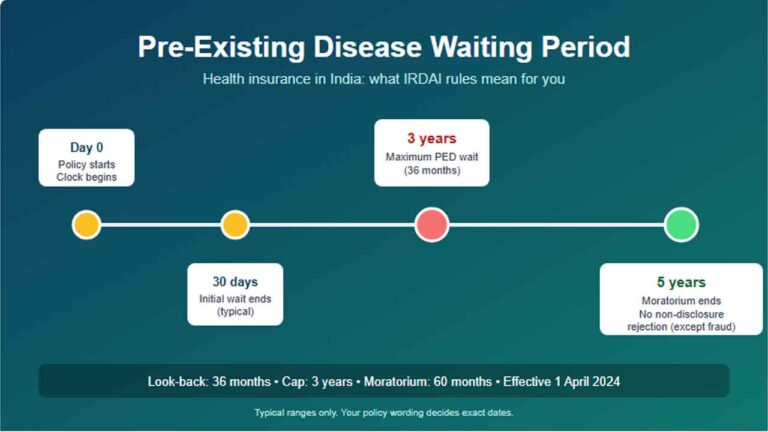
- Exclusions and waiting periods: Treatment during a waiting period is not covered. See our guide on the pre-existing disease waiting period.
Tip: Before admission, ask the hospital for an estimate and check it against your policy’s limits.
9. If your cashless request is rejected
A cashless denial is not a claim rejection. Do this:
- Ask the insurer or hospital for the written reason.
- If it is a missing document or clarification, fix it and ask for reconsideration.
- If the hospital is out of network, proceed with treatment and file for reimbursement.
- Do not delay medically necessary treatment while the dispute continues.
- Keep every bill and receipt for the reimbursement claim.
10. If your claim is rejected: how to escalate
- Ask for a written rejection letter stating the exact clause.
- Compare it with your policy wording.
- Send missing or corrected documents if the issue is technical.
- Write to the insurer’s Grievance Redressal Officer (GRO).
- Escalate through IRDAI’s Bima Bharosa portal.
- Approach the Insurance Ombudsman if it is still unresolved.
Common reasons for rejection include non-disclosure of a health condition, a claim during a waiting period, a lapsed policy, an excluded treatment, missing documents, or no pre-authorisation. Keep the policy, premium receipts, medical records, bills and all emails.
11. Common mistakes
- Assuming a hospital is in the network without checking the insurer’s current list
- Informing the insurer late, or not at all
- Not asking for the pre-authorisation number
- Losing the original bills and discharge summary
- Ignoring room-rent limits when choosing a room
- Treating a cashless denial as final
- Letting the policy lapse before a planned surgery
- Not disclosing existing conditions at purchase
12. Keep this ready at home
- Policy number and insurer helpline saved on every family member’s phone
- A photo of the health card and the policy schedule
- The insurer’s network hospital list for your city, and the nearest 2 to 3 hospitals in it
- A folder (physical and digital) for medical records
- A note with the room-rent limit, co-payment and sub-limits of your policy
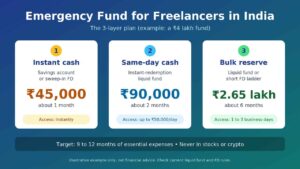
- Your emergency fund topped up to cover the gap. See our guide on the emergency fund for freelancers in India.
13. FAQs
What is the difference between cashless and reimbursement claims?
Cashless means the insurer pays the hospital directly at a network hospital. Reimbursement means you pay first and are repaid after submitting documents.
Is cashless always better?
Usually it is more convenient, but reimbursement is essential when you use a non-network hospital or a cashless request is declined.
How long does the insurer have to approve a cashless request?
IRDAI’s 2024 Master Circular asks insurers to decide within one hour and give final authorisation within three hours of the discharge request.
Do I have to inform the insurer before a planned surgery?
Yes. Most insurers ask for 48 to 72 hours’ notice for planned cashless treatment. Check your policy.
What if I forget to inform the insurer in an emergency?
Inform them as soon as possible, ideally within 24 hours, and keep proof. Late intimation can cause delays or disputes.
Can I claim for a hospital stay of less than 24 hours?
Many policies need a 24-hour stay, but listed day-care procedures are usually covered. Check your policy’s day-care list.
Can I claim pre- and post-hospitalisation expenses?
Most plans cover them for a set number of days before and after admission, with bills submitted within a stated period.
Is cashless available for group or corporate policies?
Usually yes at network hospitals, and reimbursement is often allowed at others. Check your employer’s policy document.
This article is general information based on IRDAI circulars and insurer disclosures available as of September 2026. It is not legal, medical or financial advice. Policy terms and timelines vary, so confirm in your policy wording or with your insurer.