
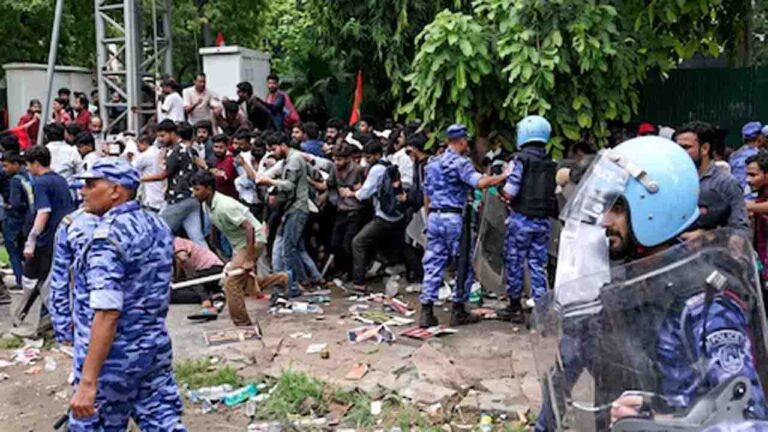

NEW DELHI: High drama unfolded at Jantar Mantar on Monday as Delhi Police baton-charged thousands of protesters participating in a ‘Sansad March’ led by the CJP. The chaos erupted on the first day of Parliament’s Monsoon Session when the demonstrators attempted to march towards the Parliament House.
To prevent the massive crowd from advancing, Delhi Police had set up multi-layered barricades. Tension escalated rapidly as the crowd pushed forward, prompting the police to resort to a lathicharge to bring the situation under control.
The police had repeatedly appealed to the protesters to call off the march, citing the enforcement of Section 163 in the New Delhi district. However, the situation took a turn when the demonstrators started pushing against the barricades in a bid to move towards Parliament Street and Rafi Marg, forcing the police to use force to disperse the crowd.
Following the lathicharge, the security apparatus was significantly tightened outside Safdarjung Hospital, where environmental activist Sonam Wangchuk is currently admitted and on a hunger strike. Expressing anger over the police action, CJP supporters alleged that the police intentionally used force against students and youth who were marching peacefully, leaving several injured.
The crackdown and subsequent unrest have turned New Delhi into a virtual fortress, completely crippling traffic movement across Lutyens’ Delhi. Key arterial stretches, including Parliament Street, Raisina Road, Rafi Marg, and Ashoka Road, have been completely blocked for general traffic.



With a heavy deployment of security forces and Rapid Action Force (RAF) riot control vehicles at Patel Chowk and Vijay Chowk, long vehicular queues were witnessed, causing major inconvenience to office-goers and commuters.
Meanwhile, the administration has issued a strict warning, stating that stringent legal action will be taken against anyone found violating Section 163 or creating a disturbance on the streets.