
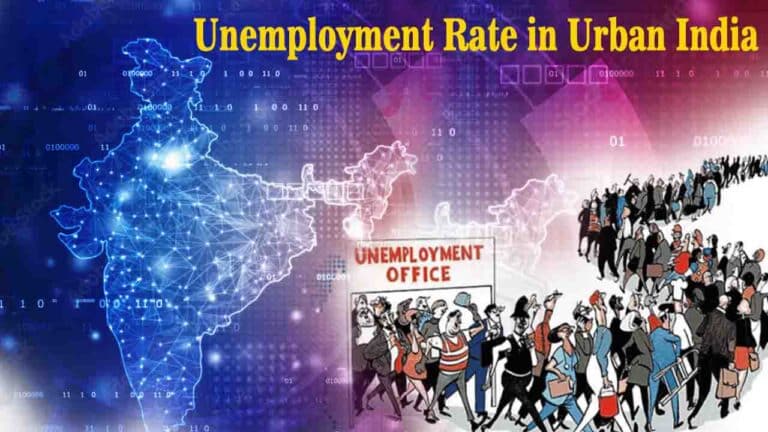
Unemployment Rate in Urban India: The Ministry of Statistics and Programme Implementation (MoSPI) has released the latest Periodic Labour Force Survey (PLFS), highlighting a positive shift in India’s urban economy. According to the report, the unemployment rate among individuals aged 15 and above in urban areas declined to 6.6% during the January-March 2026 quarter. This is a marginal yet steady improvement from the 6.7% recorded in the previous quarter of October-December 2025.
Data experts note that the overall unemployment rate in urban centers has exhibited a consistent declining trend over the last two quarters. This stability in the urban sector suggests a resilient labor market in cities, even as other sectors of the economy experience fluctuations. The distribution of workers across various employment statuses in these areas remained broadly stable, showing no major disruptions in how urban residents earn their livelihoods.
In a contrasting development, the rural job market faced slight pressure during the same period. The joblessness rate in rural India edged up to 4.3% in the March quarter, rising from the 4.0% reported in the October-December 2025 period. Despite this rise in general unemployment, there was a notable increase in regular wage and salaried employment within rural regions, which moved up to 15.5% from 14.8% in the preceding quarter.
The share of self-employed individuals across the country saw a decline, dropping to 62.5% during the March quarter from 63.2% in the previous three months. This shift indicates a change in how the workforce is structured, with more people potentially moving toward organized or sectoral labor rather than independent work. The report emphasizes that the structural pattern of employment remains largely unchanged, with rural workers still heavily reliant on the primary sector.
Agricultural engagement in rural areas saw a noticeable dip. The share of rural workers in agriculture stood at 55.8% in the March quarter, falling from 58.5% in the previous quarter. At the same time, the rural tertiary sector—which includes services—saw its share rise from 20.6% to 21.7%. Additionally, the secondary sector, including mining and quarrying in rural areas, witnessed a growth from 20.9% to 22.6% during the same timeframe.



The Labour Force Participation Rate (LFPR), which measures the percentage of the population that is either working or actively looking for work, remained relatively steady. The overall LFPR was estimated at 55.5% in the January-March 2026 quarter, compared to 55.8% in the previous period. Specifically, the urban LFPR stood at 50.2%, showing very little change from the 50.4% recorded in the preceding months.
Finally, the Worker Population Ratio (WPR) provided further insight into the employment landscape. The overall WPR was 52.8% in the March quarter, a slight decrease from 53.1% in the December quarter. While rural WPR saw a marginal decline to 55.7% from 56.1%, the urban WPR maintained its stability, settling at 46.9% compared to the earlier 47.1%. These figures reflect a period of transition as the workforce moves between sectors.