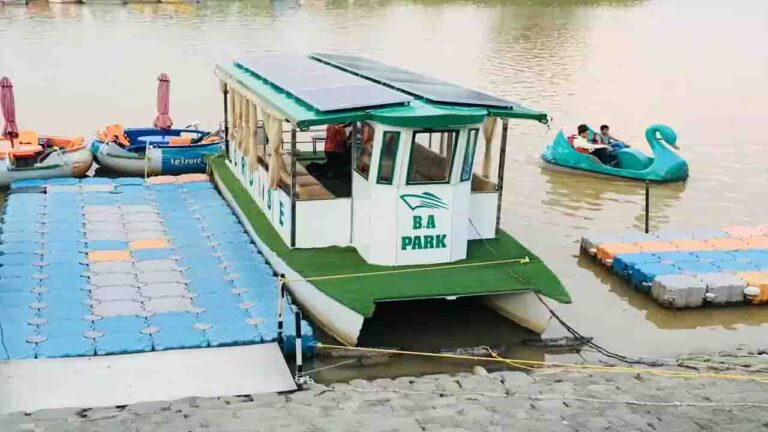

Bilaspur: The district administration of Bilaspur has issued stringent safety directives for all water activities operating in the region. The move comes in the wake of recent water-related accidents across the country, notably the Jabalpur boat tragedy in Madhya Pradesh.
Deputy Commissioner and Chairman of the District Disaster Management Authority, Rahul Kumar, issued these mandatory guidelines prioritising public safety under the Disaster Management Act, 2005. The orders are effective immediately and apply to all operations.
The directives specifically cover the large-scale boat operations, water sports, tourism activities, and ferry services operating in the Govind Sagar Lake and Kol Dam reservoir. These water bodies see significant footfall from both tourists and local residents, making safety non-negotiable. Any negligence, officials noted, could pose a severe threat to life and property.
Under the new rules, wearing a standard life jacket is compulsory for every individual participating in any water activity. Entry without a life jacket is strictly prohibited. Each boat or watercraft must mandatorily carry an adequate number of lifebuoys, life jackets of varying sizes, safety ropes, and a first-aid kit.
Furthermore, the passenger carrying capacity must be clearly displayed on every vessel, and overloading beyond the prescribed limit is completely banned. The engine capacity of motorboats must also align with the seating capacity to ensure operation at a safe speed.



The administration has made it clear that only trained and certified personnel will be deployed. Boat operators, water sports instructors, and lifeguards must possess valid certifications in swimming, rescue operations, first aid, and disaster management. The deployment of individuals without proper training or documentation is fully restricted.
Regular technical inspections of all boats, engines, and water sports equipment will be conducted by a competent authority. Any gear found unsuitable will be decommissioned immediately. Operators are also required to brief tourists on safety rules, emergency procedures, and behavioural instructions before every single trip.
Additionally, trained rescue teams, rescue boats, first-aid facilities, and emergency communication systems will be made available 24/7 at major water sites. A systematic rescue and evacuation plan will be in place to handle any emergency. Clear, multilingual warning signboards displaying water depth, weather risks, restricted zones, and safety instructions will be installed, while water activities in identified high-risk zones will be completely prohibited.
Deputy Commissioner Rahul Kumar warned that strict action will be taken against operators or agencies found violating these guidelines. Consequences include licence cancellation, financial penalties, and legal action under the Disaster Management Act, 2005. He asserted that no negligence at any level will be tolerated and there will be zero compromise on public safety.