
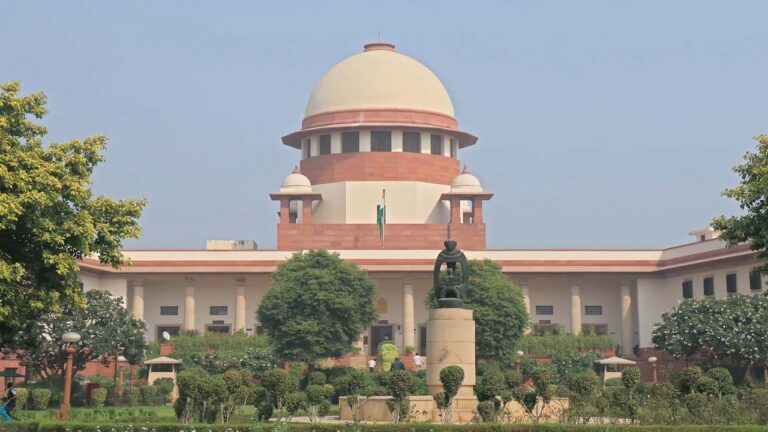
Following allegations of mass detentions, movement restrictions, and communication disruptions during protests against Chief Election Commissioner Gyanesh Kumar in Delhi, the Supreme Court issued key interim directions on Sunday. A special bench comprising Justice Joymalya Bagchi and Justice V. Mohana directed that peaceful and unarmed protesters cannot be detained except strictly in accordance with the “procedure established by law.”
The apex court also ordered that metro and railway services operate normally, internet connectivity remain undisturbed in accordance with the law, and free movement be permitted subject to lawful regulations. While the court is yet to issue a final finding on the legality of every individual detention, its order brings Article 21 of the Indian Constitution back to the center of legal discourse.
Understanding Article 21 and its Historical Context
Article 21 of the Constitution provides that no person shall be deprived of life or personal liberty except according to procedure established by law. This protection applies to every individual, not merely citizens, acting as a vital check against arbitrary state action.
During the drafting of the Constitution, the Constituent Assembly deliberated on whether to use the American phrase “due process of law” or the phrase “procedure established by law,” which was borrowed from the 1946 Japanese Constitution. Assembly members chose the latter to provide specificity. While the initial text appeared to give the legislature broader authority, subsequent judicial interpretations expanded its scope to include substantive fairness.
The Judicial Evolution: From AK Gopalan to Maneka Gandhi
In the landmark A.K. Gopalan vs State of Madras (1950) case, the Supreme Court originally took a narrow view, holding that any validly enacted state law satisfied Article 21. However, this approach was overturned in the pathbreaking Maneka Gandhi vs Union of India (1978) ruling.



The court established that a procedure depriving a person of personal liberty cannot be arbitrary, oppressive, or unfair. It ruled that Articles 14 (Equality), 19 (Freedom), and 21 (Life and Liberty) must be read together, requiring any state restriction to be just, fair, and reasonable.
Safeguards Against Arbitrary Arrests and Detentions
Article 21 operates in conjunction with Article 22, which lays down mandatory procedures during an arrest. These include informing the detainee of the grounds of arrest, granting access to legal counsel, and presenting the arrested person before a magistrate within 24 hours.
In Joginder Kumar vs State of Uttar Pradesh (1994), the Supreme Court clarified that the existence of a police power to arrest does not justify its routine exercise without clear necessity. Furthermore, the D.K. Basu vs State of West Bengal (1997) judgment established strict mandatory guidelines, such as preparing arrest memos, informing family members, and conducting medical examinations to prevent custodial abuse.
Public Order vs Personal Liberty
While Article 19 guarantees the right to assemble peacefully and express dissent, these rights remain subject to reasonable restrictions under public order. However, state authorities must demonstrate that any restriction or detention has a valid legal basis, complies with established procedures, and satisfies the principle of proportionality.
Referring to arguments raised regarding detentions beyond areas under Section 163 of the Bharatiya Nagarik Suraksha Sanhita (BNSS), the Supreme Court has required the authorities to present facts detailing the circumstances and legal justification of the detentions carried out during the Delhi protests.