
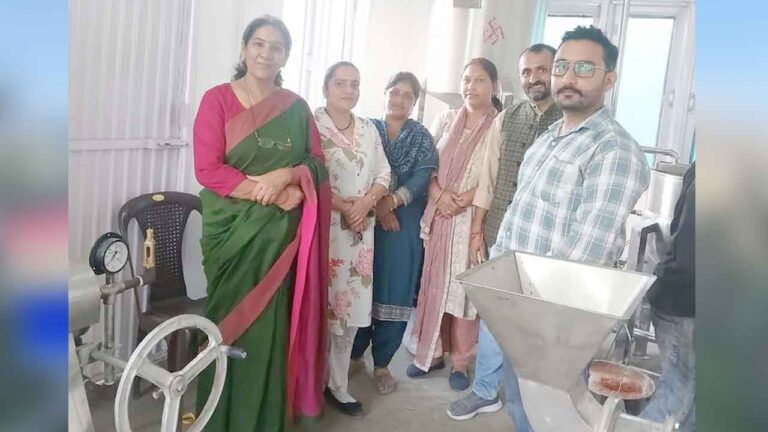
SOLAN: In a major boost to rural employment and local agriculture, the Naya Savera Community Level Federation (CLF) has set up Solan district’s first women-run tomato processing and value-addition unit at Salogra. Established under the National Rural Livelihoods Mission (NRLM) at a cost of Rs 39 lakh, the venture aims to provide tomato growers a dedicated platform to process their yield while creating sustainable livelihoods for rural women.
The facility is managed and operated by women from local Self-Help Groups (SHGs) and the CLF. Beyond processing surplus produce into tomato puree, paste, and ketchup, these women are also handling local marketing. Following a successful trial run conducted on September 30 with the support of Solan Block Development Officer Manjula Kanwar, the unit is gearing up for its formal inauguration soon.
At present, the facility processes 25 to 40 kg of tomatoes daily against a total installed capacity of 500 kg per day. “Work on key issues such as marketing and branding is under way to ensure quality and consistency in the brand,” BDO Kanwar stated. She added that help is being sought from Shoolini University to develop a dedicated app to assist with product marketing and promotional activities.
The initiative comes as a crucial intervention for Solan, widely known as the “city of red gold” for holding the state’s largest area under tomato cultivation and highest productivity. In recent times, tomato farming in the region has lost much of its appeal due to steeply rising input costs and shrinking profit margins.
To protect farmers from distress sales during market crashes, the unit will allow growers to process their produce for a fixed charge when low market prices fail to offer remunerative returns. The project materialized after a recent training programme exposed rural women to various tomato processing and value-addition techniques, sparking strong entrepreneurial interest.

While the demand for a local processing plant in Solan had been a long-standing issue raised by political parties before Assembly elections-and previously explored under the BJP government’s “One District One Product” initiative-high input costs had earlier stalled progress. The current community-led enterprise now offers a practical solution to both crop wastage and rural employment.