
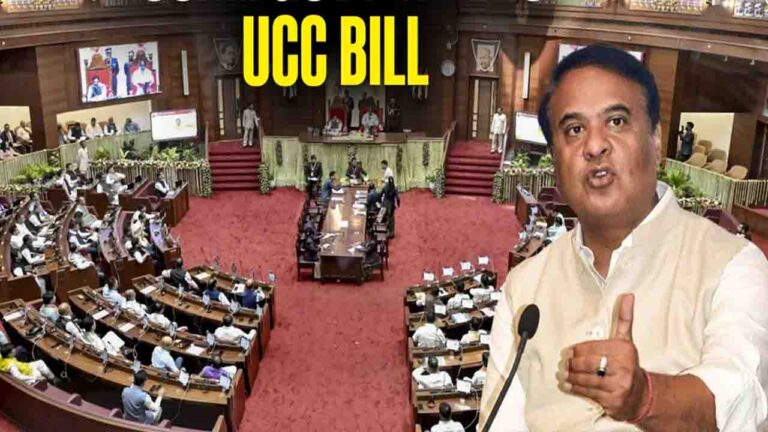
Assam UCC Bill: The Assam Assembly on Wednesday passed the contentious Uniform Civil Code (UCC) Bill by voice vote following a heated five-hour debate marked by strong opposition protests and sharp political exchanges.
The new law mandates registration of marriages, divorces and live-in relationships in cases where at least one partner is a resident of Assam. It also bans polygamy.
Assam Chief Minister Himanta Biswa Sarma described the passage of the Bill as “a watershed moment in Assam’s history” and called it a major step towards gender justice.
“Passing of this law in Assam will be a big step towards gender justice. Many have questioned why STs have been kept out of UCC. We are aware the tribals have been residing in India since long and they have their own customary laws regulating their lives, which provide rights to women and discourage polygamy. They have been kept outside as a mark of respect and because they already have their rules and regulations similar to UCC from long back,” Sarma said.
Assam has now become the third Bharatiya Janata Party-ruled state, after Uttarakhand and Gujarat, to adopt a common set of laws governing personal matters such as marriage, divorce, inheritance and succession.



The UCC has remained one of the country’s most debated political and legal issues. Article 44 of the Constitution advocates a Uniform Civil Code under the Directive Principles of State Policy. However, since Independence, personal matters have largely continued to be governed by religion-based civil laws.
The legislation in Assam, similar to those passed in Uttarakhand and Gujarat, excludes Scheduled Tribes (STs), who make up 12.45 per cent of the state’s population according to the 2011 Census.
During the debate, Opposition leaders alleged that the law was unnecessary as existing provisions already addressed issues such as polygamy and child marriage. They termed the Bill a “political stunt” and argued that it was not truly uniform because Scheduled Tribes were kept outside its scope.
They also accused the government of targeting Muslims, who account for around 34 per cent of Assam’s population.
Responding to the criticism, Sarma said the BJP had clearly promised to bring the UCC in its election manifesto.
“We had mentioned clearly in our manifesto ahead of polls that if we win, we will bring UCC. The Congress has concerns about how the Bill will affect practices followed under the Quran and the Shariat, but they haven’t mentioned once about the Bhagawat Gita or the Ramayan, which shows that the party represents just one community,” he told the Assembly.
The Chief Minister further defended the exclusion of tribal communities from the law.
“Will we treat someone who is not ill? UCC will try to give radiotherapy and chemotherapy where the cancer exists, not elsewhere,” he said.
Sarma added that the law ensures mandatory registration of marriages, divorces and live-in relationships, bans polygamy, guarantees equal succession rights for sons, daughters and elderly parents, and seeks to prevent coercion or deception in marriages and live-in relationships.
Rabiram Narzary of the Bodoland Peoples Front (BPF), a ruling alliance partner, thanked the government for excluding STs from the law’s ambit. He also sought clarification on the rights of ST women married to non-ST partners in case of divorce.
Prakash Chandra Das of the ruling Asom Gana Parishad (AGP) accused the Congress of opposing women’s rights.
“By not supporting this legislation, they have again lost an opportunity to redeem themselves,” Das said.
Congress legislature party leader Wazed Ali Choudhury argued that the UCC would infringe upon personal liberties and create social and religious tensions in a diverse country like India. He maintained that existing laws were sufficient to ensure gender justice.
Congress MLA Jakir Hussain Sikdar questioned how the legislation could be called uniform when some communities were excluded from it.
“This legislation was tabled in the House without wide consultations with political parties, social groups, religious bodies, organisations and the public. How can it be uniform if some are kept outside it, and how will it empower ST women if they are not included?” he asked while calling the law a “political stunt”.
Sikdar further argued that Assam already had laws against polygamy, child marriage, and mandatory registration of marriages and divorces.
“Why do we need UCC after all that? Since this Bill is not uniform and doesn’t cover all, I suggest that its name should be changed,” he added.
Mazibur Rahman of the All India United Democratic Front (AIUDF) claimed that implementation of the UCC would violate the fundamental rights and legal protections available to all citizens, including Muslims.
Trinamool Congress leader Sherman Ali Ahmed said he supported some provisions such as the ban on triple talaq, child marriage and mandatory registration of live-in relationships. However, he alleged that the law violated Quranic guidelines on marriage practices and was introduced with “malafide intention”.
Raijor Dal leader Akhil Gogoi also criticised the legislation, saying it could lead to harassment by officials and interfere with personal liberties.
“The Bill aims to put private relations under bureaucratic control by mandating registration of live-in relationships and issues related to it by appointing a sub-registrar who in turn will inform the local police station about such relationships,” Gogoi said.