
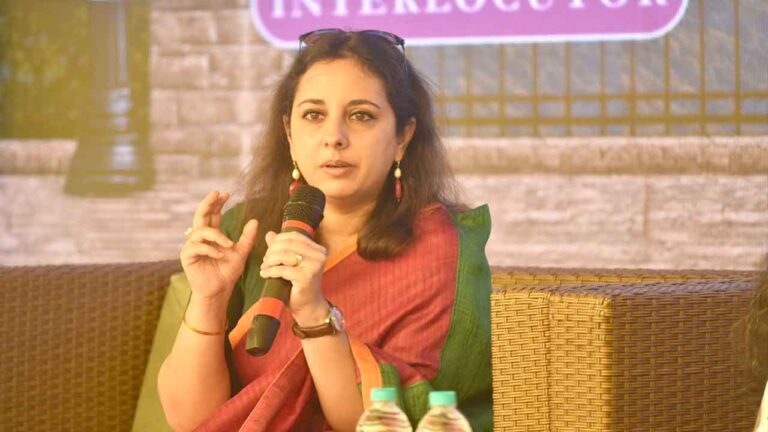
Kasauli: At Khuswant Singh Lit Fest 2026 in Kasauli, lawyer and author Mihira Sood questioned the effectiveness of fast-track courts in rape cases, saying the judiciary faces a severe shortage of resources. She called for better infrastructure, trained personnel and reforms to make justice more accessible.
Lawyer and author Mihira Sood has questioned the effectiveness of fast-track courts in rape cases, describing them as “image-based solutions” that offer little real benefit. Speaking at the session “Girls Just Want to Have Fundamental Rights” at Khuswant Singh Lit Fest (KSLF) 2026 in Kasauli on Friday, she said the biggest challenge facing India’s judicial system was a severe shortage of resources. Journalist Anna M.M. Vetticad was also present at the session.
Responding to an audience member who asked whether the feminist movement should prioritise sending all rape cases to fast-track courts, Sood said she and most lawyers believed the model was not effective in practice. She stressed that addressing the shortage of resources in the justice system should be the priority.
Delays Must Be Examined at Every Stage
Sood said the reasons for delays in rape cases needed closer examination. It was important to determine whether the delays occurred at the police level, during investigations or at trial, and who was seeking adjournments – the prosecution, the defence or the judge.
She said several timelines built into the legal system were necessary because the police needed time to investigate and file charge sheets, while lawyers required adequate time to prepare their cases. According to Sood, even after removing unnecessary delays, the overall time taken to conclude rape trials would change very little because of the heavy burden on courts.



Shortage of Resources in Courts
“Our judiciary and legal system are facing a resource crisis,” Sood said.
She pointed out that some courts were functioning without stenographers, while judges sometimes heard 100 to 150 cases a day. Lawyers, meanwhile, argued 80 to 100 cases.
She described such workloads as physically impossible to manage effectively.
Risk of Wrongful Convictions
Sood expressed concern that fast-track courts could lead to compromises in the pursuit of justice. She warned that political pressure to secure quick convictions could push the police to present someone as an accused and even fabricate evidence, particularly in cases where the accused was not known to the survivor. She cautioned that this could increase wrongful convictions, with women and the women’s rights movement eventually facing the blame.
‘Rage, Reform, Repeat’
Referring to a chapter in her book titled “Rage, Reform, Repeat”, Sood described a recurring pattern in the response to crimes that attract public attention. She said an incident makes headlines, people take to the streets, pressure builds on the government and punishments become harsher. A five-year sentence becomes 10 years, a 10-year sentence becomes 20 years, and a 20-year sentence can be replaced by the death penalty.
Sood said fast-track courts were also part of this cycle, offering the government an “easy way out” instead of addressing deeper problems in the justice system.
“We need sustained pressure,” she said.
Better Infrastructure and a More Sensitive Justice System
Sood said unnecessary delays could be reduced, but meaningful reform required trained personnel, adequate infrastructure and funding. She also called for a more humane and sensitive judicial process for survivors.
One measure, she said, was to record a survivor’s testimony as early as possible and in a single sitting, wherever applicable, so that she would not have to repeat it. Sood said this provision already existed on paper and needed to be implemented.
She also stressed that women’s rights could not be viewed in isolation, as they were connected to the rights of Dalit, Adivasi and LGBT communities. Reforming the entire judicial system, she said, would benefit social movements and marginalised communities alike.
Book Examines Five Decades of Women’s Rights
The session began with a discussion of Sood’s book, which examines the struggle for women’s rights over the past 50 years, beginning in the 1970s, through political, social and economic perspectives. Journalist Anna M.M. Vetticad described the book as one that readers did not need to be lawyers to understand.