
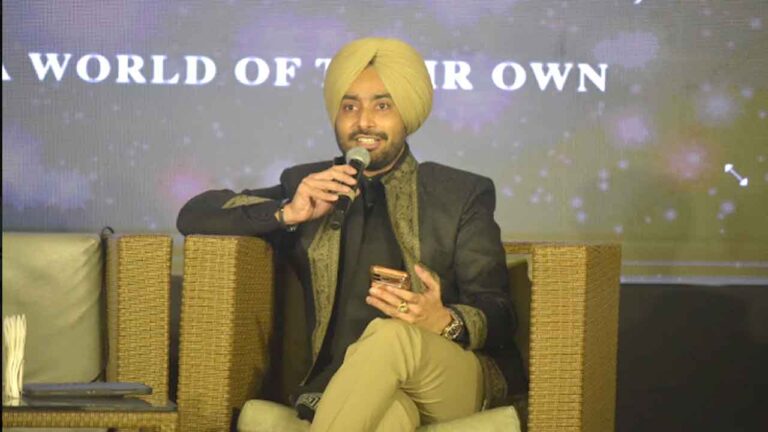
Kasauli: Punjabi singer and poet Satinder Sartaaj captivated audiences on the second day of the Khushwant Singh Lit Fest 2026 in Kasauli, bringing the event to a close with his poetry, ghazals, songs and candid reflections on life, relationships and culture.
During the session titled “Fireside Chat: Poetry and Music”, Sartaaj revealed that he had travelled directly to Kasauli after performing at a concert in Jaipur the previous night. He said his tour, “The Philosophy of Resonance”, had begun with the Jaipur show, with Karnal and Kullu scheduled as the next stops.
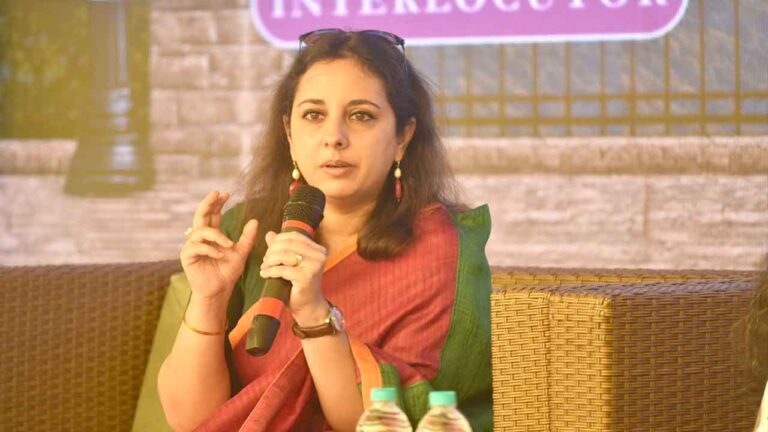
The session opened with poet, journalist and translator Nirupama Dutt speaking to writer Sandhya Mridul about her book, written in memory of her brother. Its first poem, titled “Be Strong”, explores the deeper meaning of strength in the face of grief.
Mridul said being strong meant restoring hope in a mother’s eyes, holding oneself together while looking at a brother’s photograph and finding the strength to endure waves of grief. She emphasised that people should allow themselves to feel their emotions, as this is what makes them human.
She also spoke about how people sometimes mistake vulnerability for weakness. Recalling her public image as a “cool, bold and carefree” woman, she said people began to perceive her as weak when they saw her cry. However, she stressed that there is strength in tears, too.



Sartaaj agreed that encouraging friends and helping them find strength was important. He then recited a poem on the impermanence of life, conveying the message that wealth and crowns remain behind, while love and memories accompany a person.
Sartaaj speaks about relationships, time and friendship
Sartaaj shared a new ghazal that explored the delicate nature of attachment. He said the bonds of affection were as fragile as threads, not ropes that could be pulled tighter without consequences. Those who value relationships do not attack the people they love, he said, adding that people who do not run away from pain are the ones who keep the gardens of love flourishing.
He dedicated one couplet to parents, elders, brothers and sisters who spend their lives bringing smiles to other people’s faces.
Reciting a poem he had written ten days earlier for the festive season, Sartaaj said sharing laughter was one of the easiest and least expensive things people could do. If someone had fallen out with another person, they should find an opportunity to talk and resolve the matter rather than regret it later.
Comparing this with Western individualistic culture, he said people there even knock before entering their children’s rooms, while families in India often live together. He described this closeness as a strength.
Taking a humorous dig at modern habits, Sartaaj said people who spent hours watching reels often claimed they had no time when a friend invited them out. While unnecessary spending seemed affordable, finding time for relationships had become expensive.
Using his journey to Kasauli as an example, he said that even when the main road was closed, another route was available through Mashobra. Similarly, when the path to someone’s emotions appeared blocked, another way could still be found.
He also recited a poem on friendship, reflecting on how people behave differently among friends than they do at work. Friendships have their own stories, their own kinds of disagreements and their own ways of healing, he said, adding that the remedies friends offer are not written on a doctor’s prescription.
In a light-hearted remark, he suggested that even a scientist like Einstein might have spent time drinking with friends after returning home. Other relationships, he said, come through circumstances, but friendship is something people earn for themselves.
Addressing the well-read audience, Sartaaj encouraged them to reconnect with their school and college friends and enjoy the carefree moments they once shared.
Audience joins Sartaaj in singing
Responding to requests from the audience, Sartaaj performed several songs, including “Guzarishon Pe Gaur Kijiye”, the Punjabi separation song “Saada Saarian Visar Gaiyan Raahan”, the Sufi prayer “Sai Ve” and “Na Gall Mere Vasdi Rahi”, which he connected with Kasauli.
The audience sang along and applauded. He also performed his ghazal “Mera Yog”.
Sartaaj spoke about the labels of Sufism, mysticism and spiritualism often attached to his work, saying he did not consider himself worthy of such descriptions. People assumed he meditated extensively, he said, but the state of a person meditating and that of a poet while creating something felt similar to him.
He also explained the relationship between the Sanskrit word “yog” and the Punjabi word “jog”, noting that yogis become jogis in Punjabi, as illustrated by the character of Ranjha becoming a jogi.
Make Punjabi poetry attractive to young people, says Sartaaj
During the question-and-answer session, Gurveer Singh from Ludhiana asked how young people could be encouraged to engage with Punjabi poetry.
Sartaaj said the best way to attract people to something was to make it beautiful. He cited his song “Gurmukhi Da Beta”, which he said had emerged naturally, without a specific purpose. The song later inspired thousands of children to get tattoos in the Gurmukhi script.
He said there was no need to rely on slogans; creating beautiful work and bringing it to people’s screens was enough.
To help audiences understand his Punjabi performances, Sartaaj brought a five-member team to the festival to translate his words. He said metaphors and symbols could be difficult to understand, particularly for people from Punjabi backgrounds who could not read their mother tongue.
He also announced for the first time that a collection of his poems, songs and ghazals would be released in around two months. It would include both recorded and previously unrecorded works. He said he was translating the collection into English himself to ensure that readers received the meaning he intended to convey.
Recounting his concert in Jaipur, he said non-Punjabi audiences had also attended. A woman who had returned from abroad told him that she had always felt a connection with Punjab, but that her Punjabi identity had remained suppressed for a long time.
Sartaaj recalled that when he left India, he could not read Gurmukhi. He later sat alone and wrote his first collection of Punjabi poetry.
A music student in the audience shared that listening to his interview had inspired her to pursue a BA and MA in music, followed by further studies at Panjab University. Sartaaj expressed pride in being the university’s global brand ambassador.
He said his musical journey began with Sangeet Visharad, which he started at Jalandhar Cantt, while its headquarters is in Sector 35, Chandigarh.
Sartaaj recalls his meeting with Khushwant Singh
Remembering Khushwant Singh, Sartaaj spoke about his album “Cheere Wala Sartaaj”, released in 2011-12. The album was launched at the residence of Salma Ansari, wife of former Vice-President Hamid Ansari, with actor Aamir Khan attending the event.
Sartaaj said he had a concert scheduled for that evening but found two hours in between to visit Khushwant Singh at his home. Although the writer was very old at the time, he spent considerable time talking with him.
Sartaaj also recalled reading Khushwant Singh’s book about Pakistan while pursuing his PhD at Panjab University. Bored with his academic subject, he had turned to literature, and the book helped introduce him to poetry.
He said the book moved him deeply because the shared Punjab that existed before Partition was very close to his heart. He added that he had admirers on both sides of the border.
Recalling his departure from Khushwant Singh’s home at around 7.30 pm, Sartaaj said it was dark outside, his eyes were moist and he cried alone. He later recited a poem inspired by the experience to Khushwant Singh. Its central message was that the ability to cry was one of the qualities that made human beings human.
Nature and everyday life inspire his writing
Sartaaj described language as one of humanity’s three greatest discoveries, alongside electricity and, potentially, artificial intelligence. Language, he said, was essential because it was the medium through which people expressed themselves.
He added that most of his songs were about nature, which remained his biggest source of inspiration, followed by the society around him.
Sartaaj said he often visited Kasauli and felt like settling there whenever he saw the place. He suggested that this might have been one of the reasons Khushwant Singh chose to live there and developed friendships in the hill town.
Explaining his creative process, Sartaaj said that while travelling by car from Chandigarh, he lowered the window and neither listened to music nor read or spoke to anyone. Instead, he observed everyday life along the road, from labourers at work to shopkeepers pulling down shutters and electricians climbing poles.
“This is the real book,” he said, explaining that learning to observe what was happening around oneself was a way of reading the book of life.
From a farming family to the concert stage
Asked whether singing was inherited or learned, with a reference to his photograph with Gurdas Maan, Sartaaj reflected on his journey.
He said performing on stage was his favourite work. Although he also worked in films and recording studios, he described the stage as his “darling”.
Sartaaj said he came from a farming family in the Doaba region, where families often had very small landholdings. People there generally had two options: pursue education or move abroad. He chose education.
His original ambition was to become a professor, earn the title of “Doctor” before his name and teach music at a college or university. He said he regarded what he had achieved as the result of his parents’ blessings and the efforts of previous generations.
According to Sartaaj, he continued to nurture and refine whatever opportunities came his way. Gradually, his work reached audiences, who responded by giving him their appreciation.
His appearance at the Khushwant Singh Lit Fest combined poetry, music, personal memories and reflections on the importance of language, friendship and human connection, bringing the second day’s final session to a close.