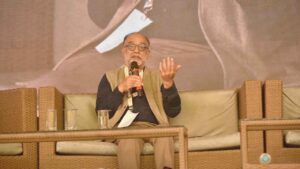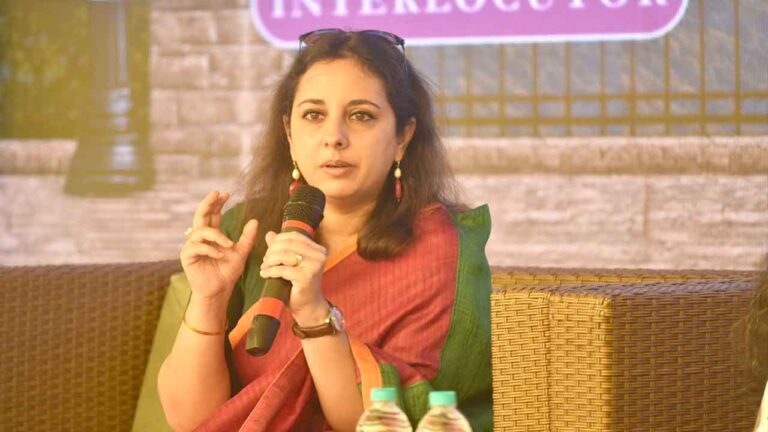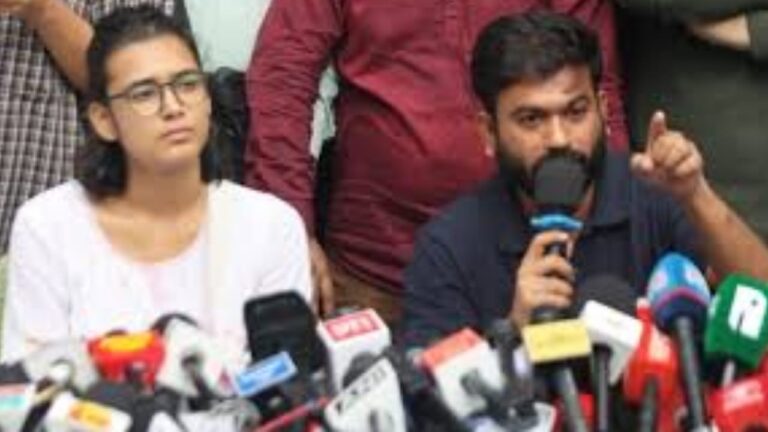

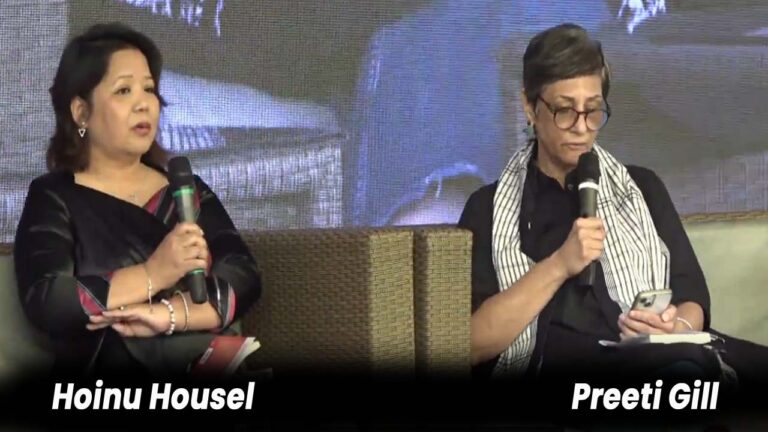
Kasauli: Journalist and author Hoihnu Hauzel questioned the media’s coverage of the Manipur violence and the delayed response to the crisis during a session at the 15th Khushwant Singh Lit Fest 2026 at the historic Kasauli Club.
Speaking at the session titled Manipur: Stories the Fire Could Not Burn, Hauzel asked whether Manipur would have received the same attention in Parliament if a photograph that shocked the nation’s conscience had not emerged. She said the parliamentary debate took place long after the incident.
Discussing her book Stories That the Fire Could Not Burn, Hauzel said people begin to question the system when their sense of security is taken away. The session was moderated by senior publishing professional Preeti Gill. The discussion highlighted the scale of the ethnic violence that erupted in Manipur in May 2023, leaving more than 300 people dead and around 60,000 displaced.
Hauzel described the book as the story of the Kuki-Zomi-Mizo community. She said it was based on the lived experiences of a community that, in her words, had repeatedly been silenced, even if its account did not form the dominant narrative. According to Hauzel, the initial difficulties following the violence had given way to what she described as deep reflection, despair and disillusionment.
Internet Shutdown and Controlled News Coverage
Hauzel said the internet was shut down immediately after the violence broke out, leaving the outside world with news reports that were heavily controlled and censored. These reports eventually reached news desks in Delhi.


She alleged that news from the Northeast often becomes a priority for Delhi-based media organisations only when violence reaches extreme levels. She also criticised newsrooms for publishing reports without adequately understanding or cross-checking their sources. According to her, this contributed to the spread of misinformation and narratives driven by particular agendas.
Hauzel said Manipur might not have received the attention it did without social media. She referred to the photograph of two women who were paraded naked after being sexually assaulted, saying it was the image that finally moved the nation’s conscience and prompted a parliamentary debate. The incident had occurred months before it came to public attention, she pointed out.
‘Words Carry Weight’
Hauzel also questioned the language used in media reports on Manipur. She said terms such as “narco-terrorists”, “opium growers” and “illegal immigrants” had been readily adopted by sections of the media. For a copy editor working far away from the ground, these might appear to be just words, she said. However, for the people labelled with them, they carried a heavy and deeply disturbing burden.
One Reporter Expected to Cover Eight States
Hauzel raised concerns over declining staff strength in media organisations. She said that while news organisations previously had reporters assigned to different states, a single reporter based in Assam was now often expected to cover the entire Northeast, comprising eight states with distinct political and social dynamics.
She described this approach as “dangerously short-sighted”. Hauzel said news coverage should not be limited to violence, but stories without fighting and bloodshed were often not considered important enough to receive attention.
She also spoke about the exhaustion faced by journalists covering the conflict. Some of her journalist friends had withdrawn from coverage, saying they were accused of bias by one side whenever they reported on the other.
In response, Hauzel launched a campaign on Twitter and tagged the country’s highest constitutional office. She said she did not know whether the effort had succeeded, but felt she had fulfilled her duty and would continue tagging the authorities.
Emergency Efforts From Gurugram
Hauzel was in Gurugram when the violence broke out. Her house was burnt down, forcing her family to flee to a neighbouring state. She said there was no time to grieve as she immediately shifted into emergency mode. She repeatedly contacted the armed forces and people in positions of authority to verify information and seek assistance.
Her parents spent seven to eight hours waiting in darkness at a neighbour’s house. They were later moved in groups to army camps, from where people were evacuated by air. Hauzel said the Army responded quickly and all its camps were used as relief camps.
She also described the difficulties faced by people fleeing the violence. Many had left without identity documents, while their phones had been left behind. Hauzel contacted people she knew and provided written guarantees for several individuals to help them obtain permission to board flights. She said she documented accounts from both sides of the conflict and found that the experience of pain and loss was shared across communities.
Hill-Valley Divide and Distance From the Centre
Hauzel highlighted the strategic importance of the Northeast, which shares borders with China, Bangladesh, Myanmar and Bhutan. She also pointed to Manipur’s extensive and open border with Myanmar. Although insurgency was not new to her, she said the complete division between Manipur’s hills and valley during the violence was different.
According to Hauzel, the Meiteis dominate the valley, where the centre of political power lies, while the hills are home to tribal communities, including the Kuki, Naga and Mizo. She said the divide had existed for years but had never been adequately addressed. She attributed the situation partly to a lack of leadership and the geographical distance between the Northeast and the Centre.
Hauzel said this distance had led people in the Northeast to regard the Centre as their “owner”, even though India belonged to everyone. She also argued that central policies were often disconnected from realities on the ground.
Questioning the region’s representation in the national narrative, she said the Northeast had still not received formal space in textbooks even after 79 years of Independence. “If this is the case, why should its neglect come as a surprise?” her remarks suggested.
She asked the audience whether such a situation should be allowed to continue in any part of India. Hauzel said the division remained evident, with most Kuki-Zomi people having left Imphal and Meiteis having left Churachandpur.
‘Losing a Home Means Losing an Identity’
Drawing parallels with Kashmir, Punjab, Palestine and Afghanistan, Hauzel said the experience of losing one’s home connected displaced people across the world. “Losing it means losing one’s identity and hope. It is an existential crisis,” she said.
She also expressed concern about the generation growing up amid insecurity and a continuing sense of loss. The session at KSLF 2026 brought the experiences of Manipur’s displaced communities into focus while raising questions about media responsibility, the language used in reporting and the long-standing divide between the state’s hills and valley.