

Himachali Viral Weddings: “Matches are made in heaven”- this adage has once again appeared to come true amidst the scenic valleys of Himachal Pradesh. In these changing times, as borders and cultures draw closer together, the marriage of Himachali women to foreign grooms is emerging as a new social trend. However, the choice made by the daughters of Himachal to select life partners on an international level remains, fundamentally, a personal decision.
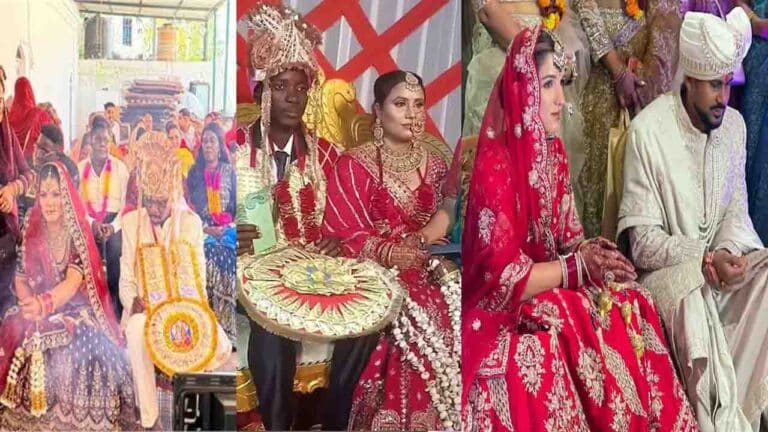
The latest instance of this trend comes from Kakkar village in the Sujanpur Assembly constituency of Hamirpur district, where a young woman chose a man from South Africa-located “seven seas away”-as her life partner. According to reports, on Tuesday, Rukmani-daughter of Savita Devi and Prithi Singh-tied the knot with Jefte Ndala from South Africa in a ceremony conducted according to traditional Hindu rites in Kakkar village.
A highlight of this wedding was that the couple-hailing from different countries and religious backgrounds-performed the Saat Pheras (seven circumambulations) in accordance with Indian traditions, pledging to remain committed to one another for a lifetime. Rukmani belongs to a Hindu family, while Jefte Ndala follows Christianity; yet, religion never became a barrier in their relationship.
It is reported that their love story began at Chandigarh University, where both were pursuing their MBA degrees. During their studies, their friendship blossomed into love, eventually leading their relationship to the altar of marriage. Today, both work and reside in the USA.
The wedding also featured a distinct international flavor. Jefte Ndala’s family-including his mother, sisters, and other relatives-traveled all the way from South Africa specifically to attend the ceremony in Himachal. According to Rukmani’s uncle, Prakash Chand, both families are delighted with this union, which is being celebrated as a beautiful confluence of the cultures of two different nations.



It is worth noting that this is not the first instance where weddings involving foreign grooms in Himachal have garnered significant attention. Prior to this, in Sirmour district, Rashika Negi-the daughter of a BJP leader-married Dumindu Vithanage, a man of Sri Lankan origin. This wedding, too, was solemnized according to Hindu rituals, during which the significance of the seven vows was explained to the groom through translation. Both individuals work in New Zealand, and the wedding procession arrived in Himachal directly from there.
Similarly, in Kangra district, mountaineer Anjali Sharma set another example of an international union by marrying Yves Kajiyuka, a young man from South Africa. This demonstrates that, with advancements in education, career opportunities, and global connectivity, the daughters of Himachal are now choosing their life partners by looking beyond geographical boundaries.
Experts believe that such marriages not only unite two individuals but also serve as a bridge connecting two distinct cultures, traditions, and nations. However, such marriages also frequently become a subject of widespread discussion among the public.
In today’s times, it is evident that love knows no boundaries-neither of country nor of religion. These daughters of Himachal have proven that when relationships are forged from the heart, no distance in the world can keep them apart. Spanning across South Africa, Sri Lanka, New Zealand, and the USA, these love stories represent not merely the union of two hearts, but a beautiful confluence of two nations, two cultures, and two continents.
It is worth noting that Himachal Pradesh frequently remains in the spotlight-not only for its international marriages but also for its unique traditional matrimonial customs. Last year, news regarding a practice in the state’s tribal regions-where two brothers marry the same woman-garnered significant headlines. This tradition, known as ‘polyandry’ (the practice of having multiple husbands), is primarily observed in certain upper-Himalayan regions, including the Giripar area of Sirmour and Kinnaur.
Social and economic factors are cited as the reasons behind this custom, such as preventing the fragmentation of family land and preserving family unity. Although this practice has largely declined in modern times, it once again becomes a subject of discussion whenever such cases occasionally come to light.