




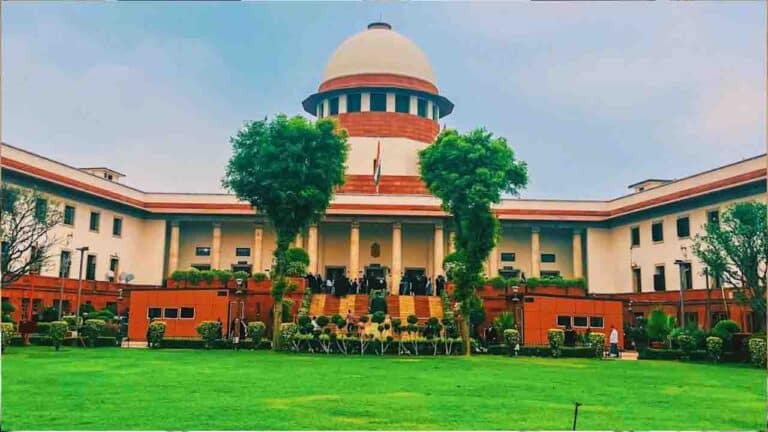

The Supreme Court on Friday heard arguments asserting that the determination of religious freedom under the Constitution requires established, uniform principles rather than ad hoc, case-by-case judicial decisions.
Addressing a nine-judge Constitution Bench headed by Chief Justice Surya Kant, senior advocate Rajeev Dhavan contended that the doctrine of “essential religious practices” has evolved through judicial pronouncements rather than explicit constitutional mandate. Dhavan traced the term’s origin to the mid-sixties, noting its emergence through various court interpretations.
Dhavan expressed reservations regarding the current application of this doctrine. He argued that the current test- determining if a religion’s fundamental character would collapse without a specific practice – places an excessive burden on petitioners. He cautioned that suggesting a religion would “collapse” if a practice were removed is an extreme standard.
The ongoing hearings, which began on April 7, have seen the Bench—comprising Justices B.V. Nagarathna, M.M. Sundresh, Ahsanuddin Amanullah, Aravind Kumar, Augustine George Masih, Prasanna B. Varale, R. Mahadevan, and Joymalya Bagchi—raise critical questions. These inquiries have centered on whether essential practices are a “juristic invention,” the scope of judicial review regarding superstitious beliefs, and the intersection of logic and faith.
Regarding the concept of “constitutional morality,” Dhavan distinguished it from “institutional morality,” which he suggested should govern the functioning of institutions. He drew parallels between the undefined nature of constitutional morality and the basic structure doctrine, emphasizing that these frameworks require clearer application when interpreting Articles 25 and 26.



The current proceedings arise from the Sabarimala reference, prompted by the 2018 judgment that permitted women of all ages to enter the Lord Ayyappa temple in Kerala. The nine-judge Bench is tasked with clarifying the scope of judicial review, balancing religious freedom with equality under Article 14, and defining the role of constitutional morality in religious disputes.
The court adjourned the matter, with hearings scheduled to resume on Tuesday, April 21, 2026.