



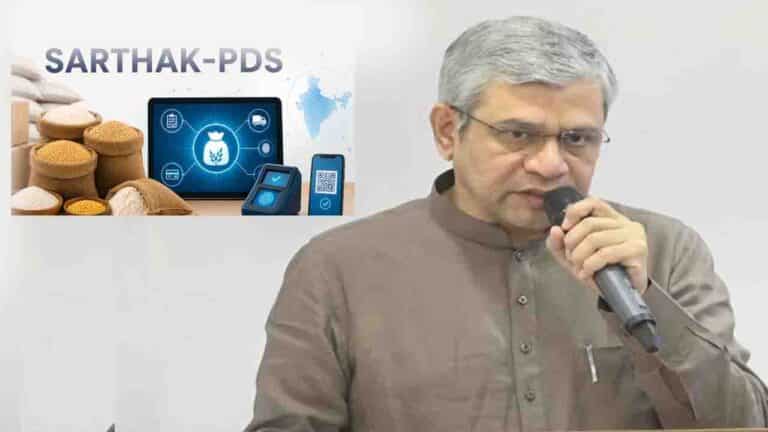

New Delhi: The Union Cabinet on Wednesday approved the continuation of the SARTHAK-PDS programme for another five years with a total allocation of ₹25,530 crore till March 2031. The move comes as the Centre pushes for deeper technology-driven reforms in the public distribution system (PDS) across the country.
The decision was taken by the Cabinet Committee on Economic Affairs (CCEA) chaired by Prime Minister Narendra Modi.
Later, Modi said in a post on X that the government remains committed to ensuring timely delivery of foodgrains to every needy person through the PDS. He said the decision to further modernise and strengthen the system would improve transparency and efficiency in delivery, logistics and transportation, while also speeding up grievance redressal.
The Cabinet also approved revised norms for Central assistance to states and union territories for intra-state transportation and handling of foodgrains. In addition, revised norms for margins of fair price shop (FPS) dealers were approved, while the existing funding structure has been retained.
Under the new SARTHAK-PDS framework, two existing schemes have been merged. These include financial support for intra-state movement of foodgrains and FPS dealer margins under the National Food Security Act (NFSA), and the SMART PDS programme focused on technology reforms.



The government said the merger aims to create a single administrative structure to improve foodgrain distribution and strengthen implementation of the NFSA.
Addressing reporters after the Cabinet meeting, Information and Broadcasting Minister Ashwini Vaishnaw said the approved scheme covers every stage of the public distribution network, from identifying beneficiaries to transportation of foodgrains and collecting citizen feedback.
“Right from selection of beneficiaries to movement of foodgrains, to getting proactive feedback from citizens, to reducing transportation distance — all those activities have been approved with an outlay of ₹25,530 crore for five years,” Vaishnaw said, according to a PTI report.
He added that several state governments had been facing difficulties in bearing the cost of transporting foodgrains to ration shops. The new scheme, he said, would support these expenses and also improve remuneration for FPS dealers.
Focus on Logistics, Grievance Redressal and Last-Mile Delivery
The government said SARTHAK-PDS is designed to modernise the existing public distribution system rather than replace it. The reforms are expected to address issues related to logistics, handling of foodgrains, transportation efficiency and grievance redressal mechanisms.
The scheme has been structured around two key objectives — ensuring continued financial support for foodgrain transportation and dealer margins, while building an integrated and citizen-oriented PDS network with interoperable systems across states and union territories.
The Centre said the reforms are aimed at improving last-mile delivery of subsidised foodgrains and reducing leakages within the distribution chain.
AI, Blockchain and Real-Time Monitoring to Strengthen PDS
A major component of the scheme includes the use of advanced technologies such as Artificial Intelligence (AI), Machine Learning (ML), Natural Language Processing (NLP) and Blockchain to streamline operations within the public distribution system.
Under the approved plan, the government intends to create unified databases and a standardised digital architecture for real-time monitoring of the PDS network. The scheme also proposes AI-enabled analytics and grievance redressal systems along with State Command Control Centres for data-based monitoring of operations.
According to the government, ISO-certified process frameworks will also be introduced to improve transparency, security standards and operational sustainability within the system.
NFSA Beneficiaries to Remain at the Centre of Reforms
The government said the programme is linked to its commitment under the National Food Security Act, which currently covers 81.35 crore beneficiaries.
“The government has a commitment to the people of the nation — a dignified life by ensuring access to food and nutritional security through the availability of adequate quantities of quality foodgrains,” the government said in a statement quoted by PTI.